
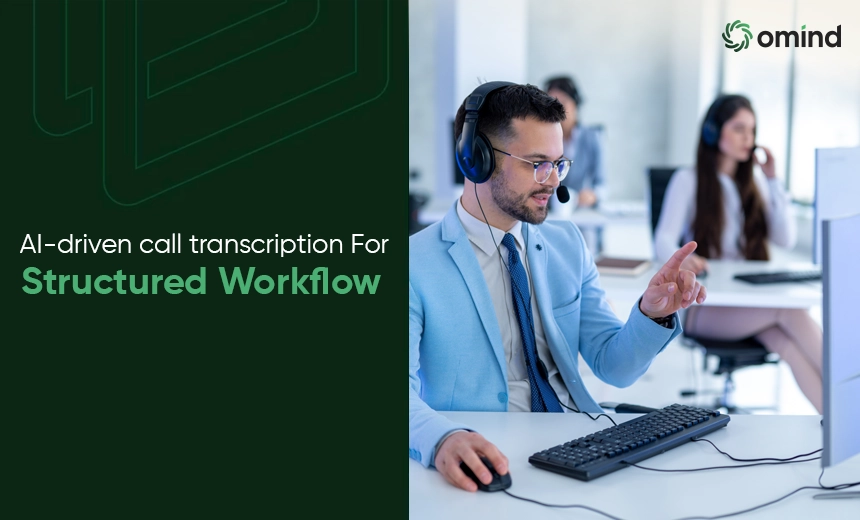

Customer experience leaders are expected to deliver consistent, compliant conversations at scale—often across thousands of calls every day. Yet the way many contact centers still audit calls has not kept pace with this reality. Manual reviews, limited sampling, and delayed evaluations make it difficult to understand what customers are experiencing across the full volume of interactions.
This gap is where AI call auditing is increasingly being explored. By using voice AI to analyze and structure conversations, CX teams can move beyond fragmented reviews toward audit-ready data that better reflects real customer experiences.
Key Takeaways
- • Manual QA samples 1–3% of calls, creating blind spots and delayed insights into real CX.
- • AI call auditing analyzes 100% of interactions, turning unstructured voice into structured, searchable data.
- • Detects sentiment, compliance gaps, and conversation patterns in real-time for proactive fixes.
- • Provides audit-ready trails with traceable evidence—strengthens defensibility and governance.
- • Aligns CX and compliance: links quality insights directly to customer journeys and outcomes.
- • Drives ROI: consistent experiences, lower risk, faster interventions—elevates QA into strategic CX tool.
Why Call Auditing Still Struggles to Keep Up?
In many organizations, call auditing is treated primarily as a compliance obligation. Quality teams sample a subset of calls, apply scorecards, and escalate issues once patterns become visible. From a CX perspective, this approach introduces several challenges.
Sampling creates blind spots. Important moments—confusion, hesitation, incomplete disclosures—often occur outside the reviewed calls. Audits are also delayed, meaning CX issues are identified only after customers have already been affected. Manual scoring further adds inconsistency, especially across teams, regions, or vendors.
Over time, these limitations affect both customer trust and regulatory confidence. When speech analytics compliance depends on partial data, neither CX nor governance teams get a complete picture of what is happening on calls.
What AI Call Auditing Means for CX and Compliance Teams at Scale?
AI call auditing changes how conversations are reviewed by shifting from periodic sampling to continuous analysis. Instead of relying solely on human reviewers, voice AI evaluates calls consistently using the same criteria across large volumes of interactions.
For CX leaders, AI call auditing supports:
- Broader visibility into conversation quality
- More consistent identification of CX and compliance signals
- Faster access to insights that typically take weeks to surface manually
This does not remove human judgment. Instead, it creates a structured foundation that allows CX, QA, and compliance teams to focus their attention where it matters most.
How Voice AI Converts Conversations into Structured Data?
Voice conversations are inherently unstructured. AI call auditing relies on voice AI to transform this raw audio into formats that can be reviewed, searched, and audited reliably.
From Unstructured Voice to Reviewable CX Signals
Voice AI applies speech recognition and contextual tagging to convert call recordings into structured data. This process captures not just what was said, but when it occurred within the conversation and how it was delivered.
For CX teams, this makes conversations easier to revisit and compare—moving beyond anecdotal reviews to evidence-based evaluation grounded in real customer interactions.
Voice AI Call Analysis Across CX Touchpoints
With voice AI call analysis, conversations can be assessed for CX-relevant signals such as interruptions, extended silences, escalation cues, or deviations from expected flows. When applied across large call volumes, these signals reveal patterns that directly influence customer perception.
Rather than isolated scores, CX leaders gain a consistent view of how conversations unfold across agents, regions, and time periods.
Structuring Data for Audit and CX Review
Once voice data is structured, it becomes suitable for audits and governance reviews. Time-stamped records, standardized evaluation inputs, and traceable outcomes make it easier to understand why a call was flagged and how conclusions were reached.
This structure supports both CX learning and defensible audit processes.
Voice AI Compliance Without Losing CX Context
Compliance failures often begin as customers experience breakdowns. A missed disclosure, unclear explanation, or rushed interaction can impact both trust and regulatory outcomes.
Voice AI compliance allows teams to consistently flag policy-relevant moments while preserving the surrounding CX context. Instead of reviewing isolated statements, teams can see how compliance requirements were met—or missed—within the full conversation.
This alignment helps organizations treat compliance and CX as connected objectives rather than competing priorities.
What “Audit-Ready Data” Looks Like for CX Leaders?
For CX leaders, audit-ready data is not just about documentation—it’s about clarity. Structured call data should make it easier to answer questions such as:
- Why was this interaction flagged?
- What evidence supports the finding?
- How frequently does this issue appear across calls?
When audit data is structured and traceable, teams spend less time interpreting results and more time improving experiences. Reviews become clearer, discussions more objective, and outcomes easier to defend.
Where AI QMS Fits into a CX-Driven Contact Center Stack?
AI call auditing typically complements existing contact center systems rather than replacing them. While CCaaS platforms manage routing and workforce tools handle staffing, an AI QMS focuses on conversation quality and governance.
For example, AI QMS by Omind supports AI call auditing within a CX-driven quality management system, structuring call data so CX and compliance teams can review conversations consistently and with clear audit trails. In this role, AI QMS works alongside existing platforms, focusing on how conversations are evaluated rather than how they are routed or staffed.
This layered approach allows organizations to strengthen call auditing without disrupting established workflows.
When CX Teams Begin Rethinking Call Auditing?
Many CX leaders begin exploring AI-based call auditing when they encounter:
- Inconsistent customer experiences across agents or regions
- Increased regulatory scrutiny of voice interactions
- Audit preparation becoming resource-intensive
- Gaps between QA findings and customer feedback
In these scenarios, AI call auditing offers a way to bring consistency and structure to conversations that were previously difficult to review at scale.
Conclusion
Call auditing does not have to remain a reactive or purely regulatory exercise. By applying voice AI thoughtfully, organizations can transform conversations into structured, audit-ready data that supports both customer experience and compliance objectives.
For CX leaders, AI call auditing represents an evolution—from limited sampling to broader visibility, and from fragmented reviews to clearer, more consistent insights. When conversations are structured with CX in mind, audits become a tool for understanding how customers are truly being served.
Exploring AI Call Auditing in Practice
For teams exploring how AI call auditing and voice AI can support structured, audit-ready call data while aligning CX and compliance priorities, AI QMS comes up as an option. We provide conversation governance embedded into modern contact center operations. Let set a personalized demo to know more.
About the Author
Robin Kundra, Head of Customer Success & Implementation at Omind, has led several AI voicebot implementations across banking, healthcare, and retail. With expertise in Voice AI solutions and a track record of enterprise CX transformations, Robin’s recommendations are anchored in deep insight and proven results.