
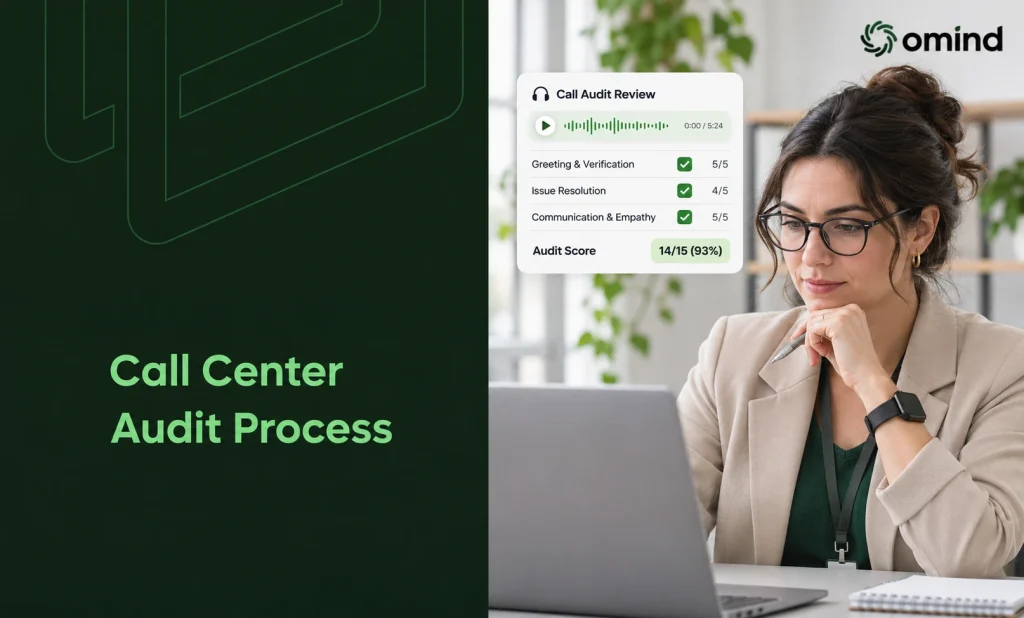
A call center audit should do more than identify poor-quality conversations. It should help quality assurance (QA) teams understand what went wrong, why it happened, and whether corrective actions actually improve performance. Yet many contact centers struggle to connect audit scores with operational improvements. Inconsistent scoring, unrepresentative call samples, and incomplete follow-up can leave recurring service problems unresolved.
A structured call center audit process addresses these gaps by connecting call selection, evaluation criteria, supporting evidence, root-cause investigation, and corrective action. This guide explains how to conduct a call center audit in seven steps, with a practical checklist, scoring examples, and reporting guidance that QA and operations teams can apply to their own workflows.
Key Takeaways
- Transform call audits from isolated agent scoring exercises into repeatable operational workflows that uncover systemic gaps and drive measurable performance gains.
- Align random, stratified, or risk-based call sampling methods with specific audit objectives and document selection criteria to prevent skewed failure rates.
- Establish observable evaluation rules, conduct reviewer calibration sessions, and log timestamped interaction evidence to eliminate subjective scoring and support defensible findings.
- Investigate root causes across policies, knowledge bases, and workflows before assigning corrective actions rather than defaulting every recurring error to agent training.
- Assign clear action owners and conduct follow-up reaudits on comparable interactions to verify whether corrective changes genuinely resolve underlying service failures.
- Leverage Omind AI QMS to automate interaction evaluations, standardize configurable audit sheets, and surface recurring quality insights while preserving human oversight.
Table of Contents
- What Is a Call Center Audit?
- How to Conduct a Call Center Audit in 7 Steps
- A Practical Call Center Audit Checklist
- What Should a Call Center Audit Report Include?
- Common Mistakes That Weaken Call Center Audits
- Where AI Call Auditing Tools Fit Into the Process?
- Build a Call Center Audit Process That Leads to Action
What Is a Call Center Audit?
A call center audit is a structured review of customer interactions against predefined quality standards, operating procedures, and applicable compliance requirements. Auditors examine call recordings, transcripts, and relevant interaction records to evaluate communication quality, information accuracy, issue resolution, documentation, and adherence to required procedures.
Unlike routine monitoring focused primarily on individual agent performance, a broader audit can also reveal recurring problems in training, knowledge resources, workflows, and operational controls.
An effective audit answers three questions:
-
What happened during the interaction?
-
Did the agent and supporting processes meet the required standards?
-
What corrective action is necessary, and how will improvement be verified?
The goal is to turn interaction evidence into operational decisions rather than treating audit scores as the final outcome.
How to Conduct a Call Center Audit in 7 Steps
A reliable audit follows a repeatable process, from defining its purpose to verifying corrective actions. Consider a hypothetical customer support team receiving repeated complaints about unclear escalation timelines. Customers are being told their issues will be escalated, but some are not informed when to expect an update.
The following steps demonstrate how a QA manager could investigate this problem.
Step 1 — Define Audit Objectives and Scope
Begin by identifying the problem the audit needs to investigate.
Audit objectives may include identifying policy deviations, understanding recurring complaints, assessing resolution accuracy, or evaluating consistency across teams.
For the escalation-timeline scenario, the objective is to determine whether agents communicate the required follow-up information during eligible calls.
The audit plan should define:
-
The customer interactions and teams included.
-
The review period.
-
The policies and quality standards being evaluated.
-
The sample-selection method.
-
The responsible reviewers and stakeholders.
-
The expected audit outputs and follow-up process.
A clearly defined scope prevents reviewers from evaluating unrelated behaviors or drawing conclusions beyond the available evidence.
Step 2 — Select Calls Using an Appropriate Sampling Method
The calls chosen for review influence what an audit can reliably conclude.
Three common selection approaches are:
- Random sampling: Select calls through a defined random process to assess routine performance. Results may support broader estimates when the sample design, size, and underlying population justify them.
- Stratified sampling: Select calls across defined groups, such as teams, shifts, or interaction categories. This helps ensure that important operating segments are included, although population proportions must be considered when interpreting aggregate findings.
- Risk-based sampling: Prioritize calls associated with complaints, escalations, or potential policy violations. This is useful for investigating specific risks but does not automatically represent overall failure rates.
In the escalation-timeline example, a QA manager might review randomly selected escalation calls alongside a separate group of complaint-related interactions. The two groups should be identified separately in the report. Findings from a risk-focused sample should not be presented as the overall failure rate without an appropriate statistical basis. Documenting the selection method makes the results easier to interpret and defend.
Step 3 — Establish Clear Audit Criteria and Scoring Rules
Before reviewing recordings, define what constitutes acceptable performance.
Typical evaluation areas include customer verification, communication quality, issue identification, information accuracy, resolution handling, documentation, and adherence to applicable policies. Each criterion should have an observable evaluation rule.
For example:
For the escalation audit, the QA team require a call center QA scorecard that would review the applicable escalation policy and establish exactly what information agents must communicate. Reviewers should also agree on how to handle incomplete recordings, unclear evidence, and criteria that do not apply.
Calibration sessions can help auditors interpret evaluation rules consistently. Critical compliance or policy failures may require separate escalation rather than being offset by a high overall quality score.
Step 4 — Review Interactions and Record Supporting Evidence
Once the audit framework is established, reviewers can evaluate the selected calls. Listen to recordings or examine authorized transcripts alongside relevant policies and interaction records.
For each interaction:
-
Identify the customer’s issue and the applicable audit criteria.
-
Compare the agent’s actions with the approved procedure.
-
Record the result for each applicable criterion.
-
Capture relevant timestamps and supporting evidence.
-
Flag unclear findings for additional review or calibration.
In the escalation example, the auditor checks whether the agent communicated the required next steps and follow-up timeline.
If the timeline was omitted, the reviewer records the failed criterion and identifies the relevant point in the recording. Importantly, the reviewer should not immediately conclude that the agent requires additional training. The failure may reflect an outdated knowledge article, unclear policy wording, or a missed procedural step. Establishing the cause requires additional investigation.
Evidence-based reviews help reduce subjective scoring and support defensible findings.
Step 5 — Identify Recurring Failures and Investigate Root Causes
After reviewing the selected interactions, group findings by issue type, frequency, severity, and affected workflow. This helps distinguish isolated mistakes from recurring operational problems. For the escalation-timeline example, the QA team may discover that multiple reviewed interactions contain the same omission.
However, observing repeated omissions does not establish why they occurred.
A structured investigation should distinguish four elements:
-
Observed failure: The required escalation timeline was not communicated.
-
Suspected root cause: Agents may be using unclear or outdated escalation guidance.
-
Investigation: Review the current policy, knowledge resources, training instructions, and relevant agent feedback.
-
Confirmed cause: Record the cause supported by the investigation, or document that the cause remains unresolved.
An unclear procedure may need revision. A knowledge-base error may require a content update. Repeated failure to follow a clear and accessible procedure may warrant targeted coaching or further management review.
Avoid assigning corrective actions based only on assumptions about agent performance.
Step 6 — Document Findings and Assign Corrective Actions
A call center audit report should make each significant finding traceable to evidence and a defined response. Include the audit objective, review period, selection method, evaluation criteria, significant findings, and responsible action owners.
For individual findings, document:
-
The applicable policy or evaluation criterion.
-
The observed failure.
-
Supporting evidence.
-
The suspected or confirmed cause.
-
The corrective action.
-
The action owner and target date.
-
The method of verifying improvement.
In the escalation scenario, a call center compliance audits and evidence management helps. The corrective action might involve clarifying the escalation procedure and reviewing the revised guidance with affected agents.
If the investigation indicates a system limitation, the action may instead require workflow or technical changes. Compliance-related findings should follow the organization’s established escalation and review procedures. An interaction audit can identify potential compliance failures, but it does not independently establish that every applicable regulatory requirement has been satisfied.
Step 7 — Reaudit and Verify Improvement
The final step is to establish whether the corrective action worked. Once the relevant changes have been implemented, review comparable interactions against the same criteria. In the escalation-timeline, the QA manager would examine new eligible escalation calls to determine whether agents now provide the required follow-up information.
The review should distinguish between:
- Interaction-level evidence: Whether agents followed the approved escalation procedure in the reviewed calls.
- Operational outcomes: Whether broader indicators, such as repeat contacts or escalation-related complaints, changed after implementation.
These measures provide different types of information. A reduction in complaints may support the assessment of an improvement, but it does not automatically prove that the audit intervention caused the change. If failures continue, reassess the original root-cause analysis and determine whether further action is needed.
A Practical Call Center Audit Checklist
A standardized checklist helps reviewers evaluate relevant interactions consistently and capture comparable evidence.
The following example can be adapted to the organization’s policies and call types.
Each result should be supported by reviewer notes or references to the relevant interaction evidence. For example, if an escalation timeline was required but omitted, the reviewer would mark the applicable criterion as failed and identify the recording segment supporting that conclusion. A criterion should be marked not applicable when the approved procedure does not require that action for the interaction.
What Should a Call Center Audit Report Include?
An effective report should explain what was evaluated, what the evidence showed, and what happens next.
Alongside the audit scope and summary findings, significant issues should have identifiable owners and a method for verifying corrective action.
The following example illustrates how a finding could be documented.
Example Call Audit Finding
Notice that the corrective action is not finalized before the cause is investigated. If the investigation confirms unclear guidance, the team may revise the relevant procedure and communicate the change to agents. In case the instructions are already correct and accessible, the appropriate action may be different. The approach helps QA leaders avoid treating every audit failure as a training problem. It also gives operations teams a clearer record of decisions, responsibilities, and unresolved issues.
Common Mistakes That Weaken Call Center Audits
Even a well-defined audit program can produce misleading results when review practices are inconsistent. Avoiding these mistakes helps make audit findings more consistent and useful for operational decision-making:
- Using Unrepresentative Call Samples: Risk-focused reviews are useful for investigating specific failures, but they should not be interpreted as representative of every interaction. Record how calls were selected and distinguish investigation findings from population-level performance estimates.
- Applying Inconsistent Evaluation Standards: Different interpretations of the same scoring criterion can reduce confidence in audit results. Use written scoring definitions, reviewer calibration, and procedures for resolving disputed assessments.
- Treating Every Error as an Agent Training Issue: Recurring failures may originate in policy design, knowledge resources, or operational systems. Investigate the underlying cause before recommending training as the default solution.
- Reporting Scores Without Evidence: A quality score does not explain the reason for failure. Connect significant findings to the relevant policy, interaction evidence, and observed behavior.
- Closing Audits Without Verifying Corrective Actions: Completing a training session or updating a procedure does not automatically mean the original problem has been resolved. Follow-up reviews should confirm whether the targeted behavior or process has improved.
Where AI Call Auditing Tools Fit Into the Process?
As interaction volumes grow, QA teams may find it difficult to review calls consistently, identify recurring problems, and organize audit evidence through manual processes alone. AI call auditing tools can support parts of this workflow by evaluating recorded interactions against configured criteria, surfacing potential quality failures, and organizing findings for review.
Omind AI QMS offers capabilities such as configurable audit sheets, automated interaction evaluation, and quality analytics that can support structured monitoring and performance analysis. These capabilities can help QA teams focus attention on relevant interactions and recurring issues. However, automated assessments still require validation, particularly when recordings contain transcription errors, ambiguous language, or situations requiring contextual judgment.
Human oversight remains important for disputed evaluations, root-cause investigation, compliance decisions, and corrective-action ownership. To understand the software capabilities in more detail, explore AI call auditing software.
Build a Call Center Audit Process That Leads to Action
A successful call center audit process connects consistent evaluation with evidence-based improvement. By defining audit objectives, selecting appropriate interactions, applying clear criteria, investigating failures, and verifying corrective actions, QA teams can move beyond isolated quality scores toward a more accountable auditing practice.
As audit programs expand, maintaining consistent evaluations and identifying recurring problems can become increasingly demanding.
Make Your Call Audit Findings Easier to Act On
Explore how Omind AI QMS supports interaction evaluation, configurable audit criteria, and quality insights that help contact center teams prioritize follow-up.
See AI QMS audit in action


