
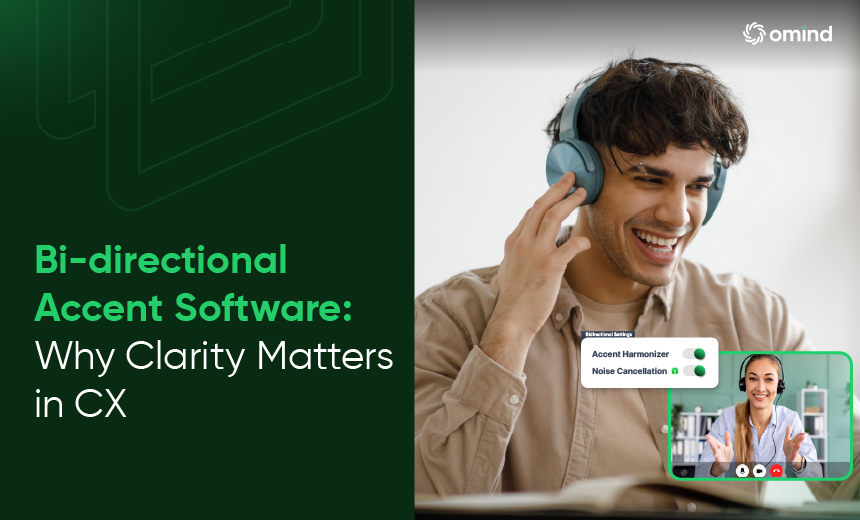

Global call centers serve a diverse customer base and staff agents from multiple linguistic backgrounds. It makes accent-related miscommunication more common. When a customer and agent struggle to understand each other, it extends Average Handle Time (AHT), increases agent fatigue, and causes a direct and costly decline in Net Promoter Scores (NPS). $1.6 Trillion is lost every year in the U.S. alone due to poor customer service, a liability your contact center cannot afford. Voice clarity software for call center helps fix these problems more quickly.
Traditionally, call centers rely on conventional VoIP clarity systems or basic noise filters. These systems have limited functionality and cannot manage human speech differences. It often stems from varying vowel sounds, intonation, and phonetic emphasis.
The next-gen bi-directional accent software directly addresses these issues. It uses advanced deep learning neural networks. Intelligent audio processing tech goes beyond what conventional clarity phone systems do. This leads to proven improvements in First Call Resolution (FCR) and significant positive movement in customer satisfaction metrics.
Key Takeaways
- • Accent friction—not background noise—is the hidden driver of longer AHT, lower FCR, and declining NPS.
- • Traditional noise cancellation fixes environment; Accent Harmonizer fixes comprehension with real-time phonetic smoothing.
- • Bi-directional processing works on both agent and customer audio streams simultaneously—no one is left struggling.
- • Preserves natural voice identity and cadence while removing only the phonetic elements that cause miscommunication.
- • Proven impact in high-stakes use cases: escalations, technical support, KYC/verification, healthcare, and outbound sales.
- • Drives ROI: fewer repetitions, faster resolutions, higher CSAT, and reduced cognitive load for agents and customers alike.
Why Traditional Noise Cancellation Fails Against Accent Gaps?
Most basic noise cancellation apps effectively workaround common ambient background noises. This solves signal quality issue, but call clarity still drops due to different accents. Accent gaps create costly delays, necessitate re-verification loops, and severely reduce First Call Resolution (FCR). Itdirectly impacts on customer satisfaction and inflates operational costs. Modern AI technology is built specifically to bridge this gap.
True Cost of Cognitive Friction
The friction places a massive cognitive load on both the agent and the customer. The listener struggles to parse unfamiliar sound, turning simple dialogue into an escalation. This struggle intensifies during high-pressure calls.
What Modern Voice Clarity Software Needs to Deliver?
Modern voice clarity software for call centers should deliver more than clean audio transmission. It must provide:
- Real-time speech enhancement that goes beyond noise reduction to address comprehension itself.
- Real-time accent harmonization normalizes speech patterns without distorting the speaker’s natural cadence.
- Bi-directional accent software capabilities that work simultaneously for both customer and agent audio streams.
- Low latency processing of voice clarity software for call center introduces no perceptible delays during live conversations.
How Accent Harmonizer by Omind Solves Accent Gap at Both Ends of the Call?
Accent Harmonizer by Omind addresses the challenge to convert speech into more neutral understandable voice patterns. It happens during active calls, with processing applied to both the agent’s and customer’s audio streams.
The bi-directional accent software enhances intelligibility without changing speaker identity. It applies targeted adjustments to fix comprehension difficulties, softening sound unfamiliar to listeners from different linguistic backgrounds.
Real-time Accent Harmonization Workflow
The workflow operates in four streamlined steps:
- Voice capture: The system captures the live voice stream as the conversation unfolds.
- Baseline smoothing: If needed, basic noise-level filtering prepares the audio for processing.
- Accent harmonization: Models trained on diverse regional speech variations apply normalization adjustments to phonetic elements, reducing comprehension friction without distorting meaning.
- Output delivery: Accent modification technology produces clearer speech that reaches the other party.
This process happens continuously during calls, with adjustments made dynamically based on the specific speech patterns detected in each conversation.
Accent Harmonizer vs Other Noise Cancellation Apps
Accent Modification Technology Use Cases
Several scenarios benefit from accent harmonization:
- Customer complaints and escalations often involve heightened emotions. The voice clarity software for call centers enables clearer communication helps de-escalate more quickly.
- Technical support and troubleshooting require precise instruction-following. When customers misinterpret steps due to accent differences, resolution times extend significantly.
- Healthcare and insurance processes demand accuracy where miscommunication can have serious consequences. Accent harmonization reduces the risk of misunderstood medical terms or policy details.
- Banking KYC and verification procedures involve repeating account numbers, addresses, and security information. Accent-related confusion during these exchanges creates security risks and frustration.
- Outbound sales calls move quickly, with limited time to build rapport. Reducing cognitive load through clearer speech helps both parties focus on the conversation’s substance rather than parsing unfamiliar pronunciation patterns.
- Training new agents from diverse linguistic backgrounds becomes more effective when they can practice with harmonized speech that demonstrates clearer pronunciation standards.
Experience Accent Harmonizer First-hand
Voice clarity challenges in call centers extend beyond environmental noise to the fundamental challenge of mutual comprehension across diverse accent patterns. Accent Harmonizer addresses this gap through real-time accent modification technology.
For teams seeking to reduce repeat explanations, improve first-call resolution, and enhance customer satisfaction through clearer communication, exploring accent harmonization represents a practical next step. Moreover, the voice clarity software for call center integrates with your existing infrastructure.
Are you ready to reduce miscommunication at contact center ?
Connect with Omind to explore Accent Harmonizer and understand how real-time, bi-directional harmonization can support your call center’s performance.
Request your demo today.
About the Author
Robin Kundra, Head of Customer Success & Implementation at Omind, has led several AI voicebot implementations across banking, healthcare, and retail. With expertise in Voice AI solutions and a track record of enterprise CX transformations, Robin’s recommendations are anchored in deep insight and proven results.