
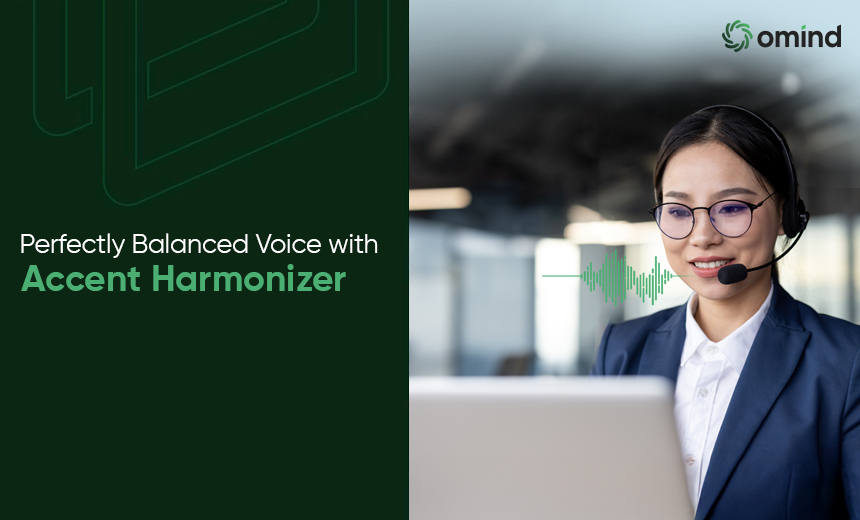

Speech is more than just sound. Every conversation carries meaning through accent, tone, rhythm, and emotion. These features reflect our culture, identity, and background. Accent harmonizer software helps make speech clearer while finding the right balance between clarity and trust.
This blog explains how real-time accent correction tool help global agents to communicate clearly and confidently with customers.
Key Takeaways
- • Accent friction adds 15–20% to AHT; harmonizer software bridges clarity gaps in global calls.
- • Traditional noise tools fix environment; AI harmonizers adjust vowels, consonants, and prosody for phonetic clarity.
- • Real-time workflow: capture speech, detect friction, reconstruct clarity—preserves tone and identity.
- • Boosts FCR, CSAT, and efficiency in high-stakes sectors like contact centers, healthcare, and BFSI.
- • Empowers agents: reduces repetition stress, frees focus for empathy and complex resolutions.
- • Drives ROI: lower AHT, faster onboarding, and seamless integration—turns clarity into competitive edge.
What Is Accent Harmonizer Software in Modern Voice AI?
Accent harmonizer software is a significant upgrade beyond traditional audio tools. The platform filters out background noise and runs advanced algorithms to perform real-time phonetic adaptation.
The software provides voice clarity enhancement, by precisely adjusting:
- Vowel Formants
- Consonant Co-articulation
- Prosodic Stress
The AI voice clarity solution like Accent Harmonizer by Omind achieves mutual intelligibility.
Why Do Enterprises Need More Than Simple Audio Enhancement?
Traditional audio tools use filters or compression to change the sound. Consumer plugins can reduce echo or make voices louder, but they cannot handle the complex sounds of real speech.
Businesses handling calls in different accents and languages need solutions that understand how speech works, not just how it sounds. That is why industries such as contact centers and healthcare now use AI voice models that adapt to conversations in real time. This is critical, as accent mismatches between agents and customers are estimated to add 15%–20% more handling time to a typical customer service call, directly increasing operational costs.
How Voice AI Pipeline Manages Audio Clarity in Real Time?
The voice AI pipeline uses advanced signal processing to maintain audio clarity. Agent communication enhancements run at sub-second intervals:
Step 1 — Capturing Live Speech with Precision
Real-time voice AI records speech in small segments, usually 10 to 30 milliseconds. The system captures these short sound snippets and assesses how background noise interferes with speech. Unlike systems that process recordings after conversations end, real-time AI makes decisions during speech, building understanding step by step as each segment arrives.
Step 2 — Phoneme-level Detection of Accented Friction
After recording speech, AI models actively identify patterns that make it hard to understand. For example, they detect long vowel sounds (when a vowel is held for too long), swapped consonants (such as pronouncing ‘b’ instead of ‘p’), or unusual tones (unexpected changes in pitch or emphasis). These models label problem areas as ‘accent friction hotspots,’ places in speech where miscommunication occurs. Real-time accent tools distinguish between normal accent features and those that cause unclear speech. The models are trained in a wide variety of speech types, so they can quickly detect differences in speaking styles that might confuse listeners.
Step 3 — Reconstructing Clarity Without Flattening Identity
The main technical skill is making changes only where needed. AI models fix sounds and preserve emotion, pitch, and style. Warmth and excitement in a voice remain, which fosters understanding, inclusion, and respect. When listeners recognize the speaker, technology builds connection and dignity, not just better comprehension. It also increases efficiency and helps conversations flow.
How AI Voice Models Preserve Naturalness While Enhancing Clarity?
Communication between agents and customers is all about building a connection. Modern voice AI begins by learning what makes each person’s voice unique. The real-time accent correction tool adapts to the individual speaker, delivering personalizedmodel adaptation instead of applying a single, generic processing rule to the entire population.
Cognitive & Behavioral Impact on Agents
AI solutions for accent clarity and confidence upgrades an agent’s performance. It helps focus 100% on the customer, providing faster problem resolution and a measurable reduction in Average Handling Time (AHT).
When agents know their speech is being clarified in real-time, they can provide:
- Authentic Engagement: Agents speak more naturally and use their full vocabulary to provide nuanced, complex explanations.
- Expert Sounding: They sound more assured, more expert, and better equipped to handle difficult, high-stakes conversations without escalation.
Voice AI Clarity Tools Make the Most Impact
Voice AI clarity is most critical in globally dispersed environments where speed and accuracy are non-negotiable. Here are some industries where agent communication enhancement platforms prove helpful:
Contact centers and BPOs
The scale of daily calls means small clarity improvements yield massive operational gains.
- Drives faster problem resolution by eliminating repetition and lowering agent-customer friction.
- Directly results in measurable KPI improvements: Reduced Average Handle Time (AHT), Lower Call Transfer Rates, and Higher Customer Satisfaction (CSAT).
Healthcare & BFSI
Clarity acts as a crucial risk management layer where miscommunication is unacceptable.
- Ensure mission-critical information (e.g., policy terms, medical instructions) is understood accurately the first time.
- Reduces compliance and legal risk by guaranteeing clarity in high-stakes, complex conversations.
Global Enterprise Collaboration & Remote Teams
Optimizes internal productivity and decision-making speed across multinational workforces.
- Removes accent friction from internal meetings (e.g., manager briefings, executive presentations) across different time zones.
- Enables seamless remote collaboration, allowing distributed teams to operate with the efficiency of co-located groups.
What to Look for in Enterprise-grade Accent Harmonizer Software?
When choosing a solution, companies should focus on two must-haves: fast processing that keeps up with conversational speed and output that preserves each speaker’s unique voice. If a system causes delays or makes people sound fake, it is not good enough. Ask vendors how they keep voices natural and request live demos, not just pre-recorded samples.
Consider using the following checklist when assessing vendors:
– What is the latency guarantees for real-time processing?
– Which accents and languages do the system support?
– How easily can the solution integrate with current telephony and CCaaS platforms?
– How does the vendor ensure the preservation of natural voice characteristics?
These questions can help leaders compare solutions and make informed decisions.
Conclusion
Accent harmonization software helps people communicate better without losing human touch. The modern AI clarity solution, like Omind’s Accent Harmonizer delivers:
- Operational Efficiency: By performing real-time phonetic adaptation, the AI dramatically cuts down on repetition and miscommunication, leading to a measurable reduction in AHT and an increase in FCR.
- Risk Mitigation: In regulated sectors (Healthcare, BFSI), it acts as a mission-critical risk management layer, ensuring vital information is conveyed perfectly, the first time, every time.
- Agent Empowerment: It removes the exhausting burden of pronunciation anxiety, freeing up the agent’s cognitive load to focus 100% on the customer, which enhances performance, confidence, and retention.
Are you ready to improve your team’s capacity? Start by booking a real-time demo with Omind to find out more. Our experts help you asses latency guarantees and identity preservation models
About the Author
Robin Kundra, Head of Customer Success & Implementation at Omind, has led several AI voicebot implementations across banking, healthcare, and retail. With expertise in Voice AI solutions and a track record of enterprise CX transformations, Robin’s recommendations are anchored in deep insight and proven results.