
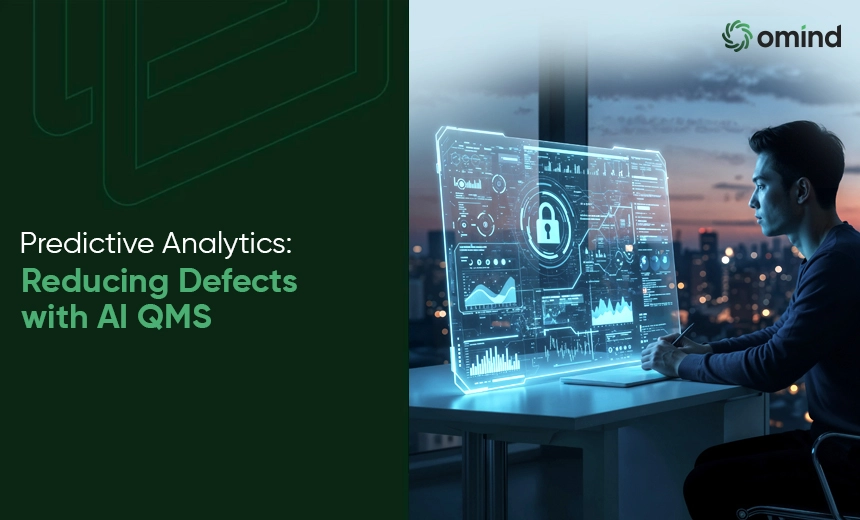

Many quality leaders feel frustrated because traditional QA frameworks only find problems after customers are already affected. Most teams still review a small sample of interactions, score them manually, and address issues with delayed coaching. In busy contact centers, this reactive method limits visibility, slows progress, and allows future risks to go unnoticed.
Industry experts agree that predictive analytics QMS software is changing quality management by helping teams prevent defects rather than just find them. Instead of reviewing only a few conversations, predictive models analyze real-time patterns, spot early warning signs, and alert supervisors before issues get worse.
Key Takeaways
- • Traditional QA samples 1–3% of interactions, missing patterns and delaying coaching.
- • Predictive analytics QMS analyzes 100% of data to forecast risks before defects occur.
- • Detects early signals: sentiment shifts, script deviations, compliance gaps, and behavior drift.
- • Enables proactive coaching, root-cause fixes, and process refinements for defect prevention.
- • Supports configurable scorecards, explainable models, and integrated workflows for regulated industries.
- • Drives ROI: shifts QA from reactive to predictive—cuts defects, boosts compliance, and elevates CX.
Why Traditional QA Struggles to Prevent Defects?
A good quality program should be accurate, visible, and consistent. Manual QA frameworks often fall short because they were built for smaller workloads and simpler customer needs.
Constraints in Conventional QA
- Sampling Gaps: Reviewing 1–3% of interactions prevents analysts from seeing systemic patterns. Traditional manual review typically captures only 1-3% of total communications, leaving organizations vulnerable to undetected, systemic compliance failures in the remaining 97% of interactions. This limited coverage is the primary exposure point for severe financial risks, such as GDPR penalties or CCPA fines, which can reach millions.
- Subjective Scoring: Coaching sessions often occur days or weeks after performance issues arise, contributing to the hidden costs of manual QA.
- Compliance Blind Spots: Script deviations, disclosure errors, or risky statements may go unnoticed.
- Late Detection of Performance Drift: Emerging behavioral issues rarely surface early.
Predictive analytics addresses these problems by finding warning signs earlier and with greater reliability.
How Does Predictive Analytics in QMS Systems Work?
Predictive analytics QMS software uses machine learning to review interaction data and predict risks or errors before they occur. The software typically focuses on four main areas.
1. Scaled Quality Monitoring Analytics
Instead of sampling, the system reviews every interaction. This helps the platform find:
- Behavior patterns linked with lower CX scores
- Recurring knowledge gaps
- Sentiment or tone variations that may indicate agent stress
- Repeated process errors or prolonged handle times
Predictive QA platforms for BPOs provide teams with a strong foundation for accurate predictions.
2. Performance Prediction in Call Centers
Predictive models surface early indicators that correlate with potential defects, such as:
- Rising negative sentiment
- Consistent script deviation
- High-frequency customer escalation keywords
- Repeated misunderstanding or back-and-forth
- Irregular silence patterns or talk-time imbalances
These signals help supervisors identify where problems could begin.
3. Predictive Risk Alerts
Instead of waiting for a dip in QA scores, predictive QA analytics tools send early notifications about:
- Quality drift
- High-risk compliance patterns
- Potential error spikes
- Changes in behavior that historically correlate with defects
This approach allows teams to take action early, rather than just react to problems after they occur.
4. Automated Root-Cause Interpretation
The performance prediction system in call centers highlights the likely contributors to future defects. Examples include:
- Knowledge base inconsistencies
- Process steps agents frequently miss
- Complex product features are frequently misunderstood
- High-effort moments in journeys such as verification, payment, or troubleshooting
These insights help leaders address the root causes, not just the symptoms.
Why Do Predictive Analytics Supports Defect Reduction?
The main benefit of predictive analytics is preventing problems, not just measuring them. When teams spot risks earlier, they can act sooner and reduce future defects.
Key Preventative Advantages
- Earlier Intervention: Supervisors can act before an issue escalates. Real-time insight generation techniques can boost First-Call Resolution (FCR) rates by over 11 percentage points and reduce Average Handle Time (AHT) by more than 25%.
- Consistent Coaching Guidance: Forecast-based recommendations improve the precision of coaching.
- Improved Process Reliability: Repeated errors reveal systemic issues in the process.
- Compliance Reinforcement: Predictive systems ensure adherence by tracking industry-specific regulatory patterns (e.g., HIPAA/GDPR) and providing an automated audit log that confirms proactive, consistent intervention.
- Greater Team Consistency: Agents receive real-time guidance tied to predictable behavior patterns.
Predictive QA platforms for BPOs help teams plan ahead, making these tools more valuable than ever.
Modern Predictive-driven Quality System Should Include
For predictive quality management to be an authoritative tool, a platform must support the following:
1. Unified Omnichannel Data & Context Ingestion
Voice transcripts, chat logs, email threads, and bot interactions should all be reviewed and combined. The system needs to organize this data and retain key details, such as customer effort score or lifetime value, so predictive models can learn from a clear, complete view of customer risks.
2. Role-specific Scorecards and Metrics
Instead of relying on fixed templates, the system should allow QA and training teams to set their own criteria aligned with business goals, such as compliance, FCR, or upsell success. This control, along with version history and audit trails, shows the system is trustworthy and flexible in real QA situations.
3. Interpretable and Explainable Predictive Models
Your system cannot be a “black box.” It must clearly show why an interaction was flagged as high-risk. This feature directly addresses the rising global regulatory mandate for transparency. For instance, the EU’s GDPR grants individuals the “right to an explanation” for automated decisions affecting them, and the NIST AI Risk Management Framework emphasizes “Explainability” as a core principle for building trustworthy AI. Without this auditable logic, your predictive system becomes a liability rather than a risk mitigator.
4. Automated and Integrated Coaching Workflows
When a problem is found, the system should start a workflow immediately. Improvement tasks should be automatically assigned to the right agents or trainers and easily fit into current Learning Management Systems or CRM tools. This forms the foundation for effective quality coaching with AI-driven insights.
5. Risk-aware Compliance Monitoring with Pattern Detection
Compliance tracking should be proactive, not reactive. The system needs built-in rules for industry regulations, such as HIPAA, GDPR, or PCI-DSS. It should also track unusual patterns, such as a sudden rise in disclosure failures within a team, and maintain an audit log to demonstrate consistent, reliable compliance.
Where Omind’s AI QMS Fits in This Predictive Evolution?
Predictive QA platforms evaluate:
- Full-interaction datasets
- Detect behavioral signals
- Support continuous coaching.
- Forecast performance drift
- Automate quality monitoring analytics.
- Generate real-time coaching insights
Omind’s AI QMS meets these needs by using predictive modeling for scoring, behavior analysis, risk detection, and coaching.
Capabilities include
- Predictive analytics-driven scoring
- Early performance and compliance signals
- Automated call evaluations across channels
- Behavior-anchored coaching journeys
- Sentiment and effort trend analysis
Conclusion
Predictive analytics helps today’s contact centers manage quality better. These models spot risks sooner, support more accurate coaching, and reduce differences across large teams. This shift turns quality management from reacting to problems into preventing them. As organizations update their QA systems, predictive analytics QMS software is the best way to cut defects, improve compliance, and help agents grow.
The platform is built to support this change by adding predictive tools directly into daily quality tasks. The advanced system helps teams turn early insights into lasting performance improvements.
Identify risks before they grow. Move your QA approach from reacting to predicting.
Learn how Omind’s AI QMS uses predictive analytics to cut defects, improve coaching, and boost compliance in every interaction. Book a demo today.
About the Author
Robin Kundra, Head of Customer Success & Implementation at Omind, has led several AI voicebot implementations across banking, healthcare, and retail. With expertise in Voice AI solutions and a track record of enterprise CX transformations, Robin’s recommendations are anchored in deep insight and proven results.