
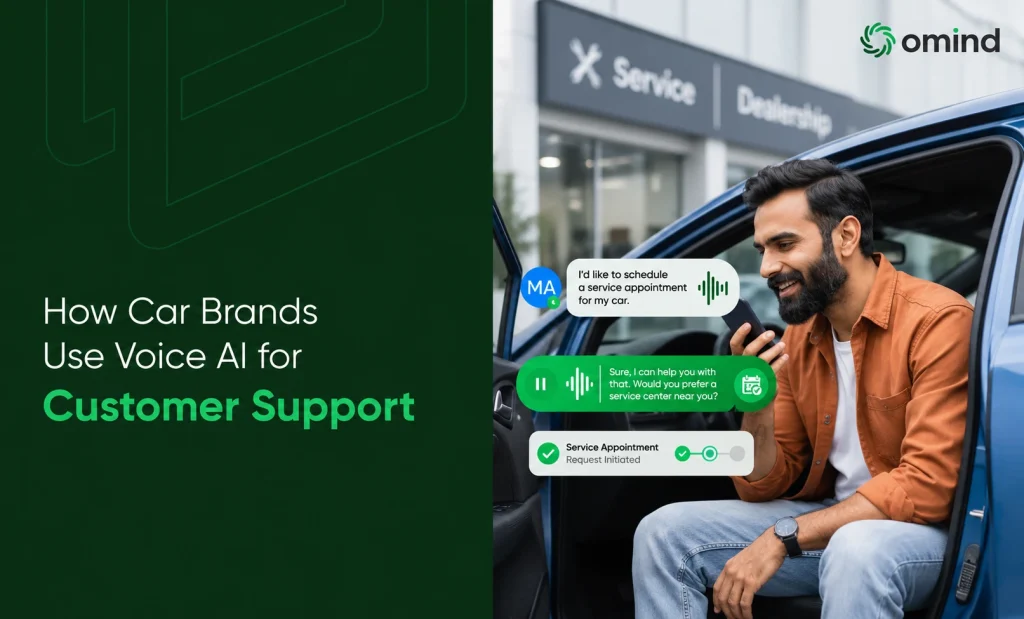
Automotive voice AI serves two different purposes. Inside vehicles, it allows drivers to interact with navigation, entertainment, and supported vehicle functions. Outside vehicles, conversational AI helps automotive businesses manage customer inquiries, sales conversations, service requests, and follow-ups.
Both applications use spoken interaction, but they operate in different environments and solve different problems. A driver asking a vehicle to find the nearest charging station needs a response from an in-car assistant. A customer calling a dealership about a charging issue needs information, appropriate service intake, or assistance from a qualified employee.
For automotive CX leaders and operations teams, understanding this difference is the starting point for identifying where Voice AI can contribute to customer communication—and where human expertise remains essential.
Key Takeaways
- Separate in-vehicle assistants from customer-facing Voice AI, as business deployments rely on telephony, CRM integrations, and approved knowledge workflows.
- Automate repeatable lifecycle touchpoints—such as sales lead qualification, service intake, and post-repair follow-ups—while reserving negotiations and diagnostics for human specialists.
- Distinguish between calls answered and issues resolved by enforcing strict escalation guardrails for safety hazards, warranty disputes, and unvalidated bookings.
- Validate backend system permissions and test edge-case interruptions before deployment to ensure voice agents handle real-world caller friction reliably.
- Measure operational impact through qualified inquiry completion, verified appointment outcomes, successful human handoffs, and repeat contact rates rather than call volume alone.
Table of Contents
- What Is Automotive Voice AI?
- How Automotive Voice AI Works Across the Customer Journey?
- Where Voice AI Helps Automotive Customer Support Teams
- What Automotive Voice AI Cannot Safely Handle on Its Own
- What Automotive Businesses Should Evaluate Before Deploying Voice AI
- How to Measure Automotive Voice AI Performance?
- Where Omind Voice AI Fits in Automotive Customer Communication
- Bring Voice AI Into the Right Automotive Conversations
What Is Automotive Voice AI?
Automotive voice AI refers to speech-based technology that interprets spoken requests and responds with information or performs supported actions.
Depending on the application, it may use speech recognition, natural language processing, conversational AI, and integrations with relevant systems.
The distinction lies in what the technology connects to and what the user expects it to accomplish.
In-Vehicle Voice Assistants
In-car assistants are designed to make supported vehicle functions accessible through spoken commands. For example, the BMW Intelligent Personal Assistant supports commands involving navigation, climate settings, communication, entertainment, and vehicle information.
Similarly, the Mercedes-Benz MBUX Voice Assistant provides voice access to supported navigation, media, communication, and vehicle functions. These are examples of manufacturer-developed automotive voice interfaces. Availability depends on vehicle equipment, software, market, and connected services.
Customer-Facing Voice AI
Customer-facing Voice AI works outside the vehicle. An automotive business might use an AI voice agent to answer an incoming call, identify the customer’s request, provide approved information, or collect details for an employee.
It can also support configured outbound communication, such as customer follow-ups or appointment reminders. Unlike embedded vehicle assistants, these systems depend on business workflows, telephony infrastructure, knowledge sources, permissions, and validated integrations.
How Automotive Voice AI Works Across the Customer Journey?
A vehicle purchase may be a single transaction, but automotive customer communication continues through research, ownership, maintenance, and after-sales service.
Different stages require different levels of automation.
Before Purchase — Vehicle Inquiries and Sales Qualification
Consider a customer calling a dealership group to inquire about an electric SUV. An AI voice agent can identify the customer’s interest, collect contact information, ask about purchase timing, and record a preferred location.
The next action depends on the available systems. If an approved inventory integration exists, the agent may retrieve relevant information. Otherwise, it should capture the inquiry for a sales representative rather than promise availability.
A salesperson remains responsible for discussions involving pricing exceptions, negotiations, financing options, and individual recommendations. This is where conversational automation may reduce repetitive intake without attempting to replace consultative selling.
After Purchase — Service Questions and Customer Communication
Automotive support becomes more complicated when customers report vehicle problems. Imagine a customer contacting a service center because a dashboard warning light has appeared. The initial conversation can collect the vehicle model, reported warning, contact details, and other information required by the service team.
However, recording a warning-light description is not equivalent to diagnosing the underlying problem. If the customer reports a safety concern, the workflow should follow approved escalation procedures rather than offering unsupported advice about whether the vehicle is safe to operate. Detailed service capacity, scheduling, and overflow workflows are covered separately in AI voice agents for automotive service operations.
Ongoing Ownership — Reminders and Follow-Ups
Automotive businesses also need to maintain customer communication after a sale or service visit. Structured outbound workflows can support service reminders, follow-up inquiries, and customer feedback collection. For example, a service department may want to contact customers who recently completed a repair.
A configured voice agent could ask whether the customer needs additional assistance and record the response. If the customer reports an unresolved problem, the appropriate next step may be a human callback rather than another automated message. Outbound communication must follow applicable calling requirements, approved campaign rules, and customer contact preferences.
Where Voice AI Helps Automotive Customer Support Teams
Automotive conversational AI is most practical when the requested task is repeatable, the information is available, and the permitted next action is clear.
The following examples illustrate where automated assistance may be appropriate and where human judgment should take priority.
These examples show why automotive organizations should distinguish between an interaction that is answered and one that is resolved. A voice agent may capture a complaint accurately, but the underlying issue could remain open. Similarly, a handoff is useful only when the request reaches the appropriate person or follow-up process. For a broader discussion of these distinctions, see Voice AI customer support automation.
What Automotive Voice AI Cannot Safely Handle on Its Own
Automotive customer interactions involve technical, financial, and sometimes safety-critical decisions. An AI voice agent should operate within clearly defined responsibilities.
- Vehicle diagnosis: Collecting a customer’s description of a mechanical issue is not a substitute for inspection by qualified automotive professionals.
- Safety-related requests: Reports of braking problems, smoke, collisions, or other urgent conditions require appropriate safety and escalation procedures. An agent should not provide unsupported assurances.
- Warranty eligibility: General policy explanations may be automated using approved information. Individual claims, disputed coverage, and exceptions may require access to records and authorized human decisions.
- Appointment confirmation: An agent can collect a preferred time, but an appointment should only be described as confirmed when the relevant scheduling system validates the booking.
- Customer complaints: Emotional, disputed, or high-impact situations may require discretion and accountability that automated workflows are not authorized to provide.
The purpose of these boundaries is not to prevent useful automation. It is to ensure that customer requests move toward an appropriate outcome without creating additional risk.
What Automotive Businesses Should Evaluate Before Deploying Voice AI
A convincing voice demonstration is not sufficient evidence that a system is ready for an automotive customer operation. The starting point should be identifying which interactions are suitable for automation.
Start With the Right Customer Request
Consider a dealership group evaluating two workflows. The first involves routine calls from prospective buyers asking about vehicles, business hours, and next steps. The second involves customers disputing warranty decisions after expensive repairs.
Both create inbound call demand, but they require different levels of judgment and system access. The first may be a reasonable candidate for structured intake and approved information delivery. The second involves customer-specific policy interpretation, financial consequences, and potentially disputed records. Human review is likely to play a greater role.
This distinction should influence the first deployment decision.
Validate the Systems Behind the Conversation
Before implementation, establish whether the workflow requires access to inventory, customer records, scheduling information, or service history. A voice agent can collect information without necessarily being authorized to retrieve or modify those records.
Where external systems are involved, define which actions are supported, how errors are handled, and how successful transactions will be verified.
Test Exceptions, Not Just Ideal Conversations
Automotive businesses should test situations such as a customer describing multiple vehicle problems, requesting unavailable information, interrupting the agent, or disputing an earlier answer.
The evaluation should establish what happens when the request cannot be completed—not merely whether the AI recognizes the customer’s initial question.
How to Measure Automotive Voice AI Performance?
Automotive teams should connect Voice AI reporting to the specific customer workflow being automated.
Four measures can provide a useful starting point:
A high number of answered calls does not necessarily indicate better customer service. For example, if an AI agent records a warranty complaint but the customer repeatedly calls because nobody follows up, the initial interaction has not achieved the intended operational outcome. Measures should reflect the business’s actual responsibilities and available data rather than automatically treating call containment as resolution.
Where Omind Voice AI Fits in Automotive Customer Communication
Omind Voice AI supports configurable inbound and outbound conversational workflows for business phone interactions. For automotive organizations, relevant applications may include customer inquiry intake, lead qualification, approved knowledge-based responses, service request information gathering, and structured follow-ups. The platform also supports human handoff and integration options through supported APIs, webhooks, and configured workflows.
Consider an automotive service provider that receives repeated calls asking for maintenance information. A configured agent could answer approved general questions, collect the reason for a service request, and direct an eligible call to a team member. Whether it can access an individual customer’s service history, retrieve live availability, or update a dealership system depends on validated integrations and authorized business processes.
Omind Voice AI is not positioned as an embedded vehicle assistant or automotive diagnostic platform. Its potential role is supporting the business conversations surrounding vehicle sales, ownership, and service.
Bring Voice AI Into the Right Automotive Conversations
Automotive voice AI extends beyond the dashboard. While in-car assistants help drivers interact with vehicle technology, customer-facing voice agents support the communication between automotive businesses and their customers. For automotive organizations, the most useful applications begin with a clear understanding of customer intent, the information required, and the decisions that should remain with qualified employees. The right deployment is not necessarily the one that automates the most calls. It is the one that helps more customer interactions reach an appropriate, measurable next step.
See Where Voice AI Fits Into Your Automotive Customer Conversations
Explore how Omind Voice AI could support customer inquiry intake, follow-up communication, and human escalation within your automotive operation.


