A voicebot reports 90% intent accuracy. That sounds reassuring until the contact center discovers that cancellation requests are frequently misclassified, billing changes fail, and some callers must repeat their problems to human agents.
For enterprise contact centers, AI voicebot accuracy must be evaluated by workflow, error type, and customer outcome. The goal is not simply to improve a model score. It is to identify why interactions fail, prioritize the failures that matter, and confirm that corrective actions work.
Key Takeaways
- •A single 90% intent accuracy score hides critical failures in high-risk workflows like cancellations and billing changes.
- •Measure accuracy across four layers: speech recognition (WER), intent recognition, action accuracy, and recovery performance.
- •Evaluate by individual intent and workflow—overall metrics distort risk in customer-churn and compliance scenarios.
- •Diagnose failures with evidence: audio/transcripts, labeled intents, workflow traces, API responses, and escalation logs.
- •Prioritize fixes by frequency, customer/business impact, and recoverability—not just the most visible dashboard errors.
- •Improve through controlled cycles: isolate, apply targeted correction, retest affected + successful cases, then validate production outcomes.
Table of Contents
- What Does AI Voicebot Accuracy Measure?
- How Should Contact Centers Measure Accuracy by Intent and Workflow?
- How Do You Identify Which Part of a Voicebot Interaction Failed?
- Which Voicebot Accuracy Problems Should Be Fixed First?
- How Can Teams Improve Accuracy Without Introducing New Failures?
- How Do Accuracy Improvements Affect Contact Center Outcomes?
- Accurate Voicebots Require Accurate Diagnosis
What Does AI Voicebot Accuracy Measure?
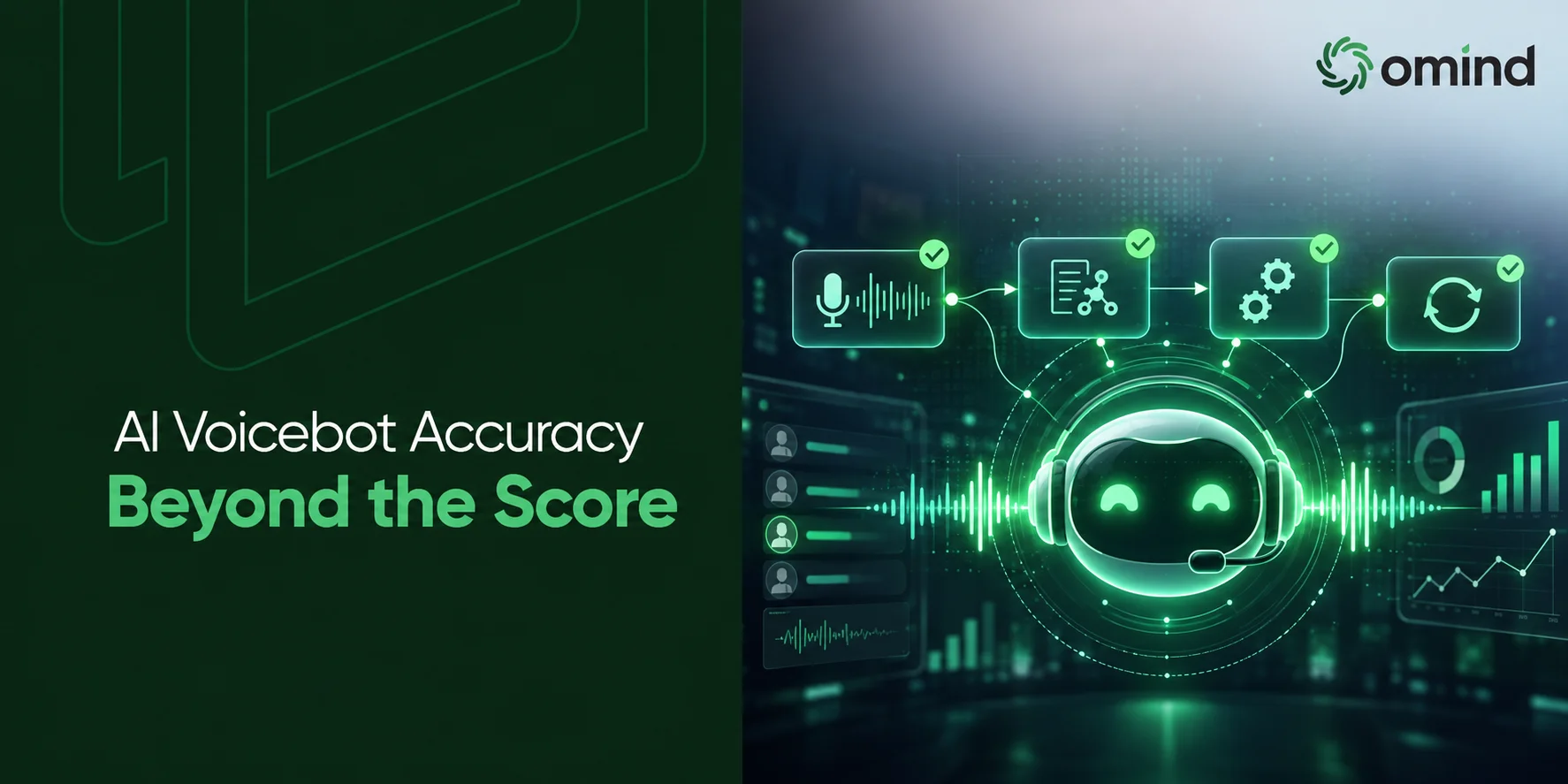
An enterprise voicebot operates through a multi-tiered execution stack, where a failure at any single point disrupts the entire interaction. Evaluating performance requires diagnosing four distinct layers:
Each layer needs a different evaluation method. Speech recognition is commonly measured using Word Error Rate (WER), which compares a transcript against reference speech. Lower WER means fewer transcription errors.
Intent recognition can be evaluated against human-labeled requests. Action accuracy requires checking execution against expected behavior and backend records. Recovery requires a different assessment: did the system clarify, retry when permitted, or escalate appropriately?
An agent can perform well at speech recognition while failing the customer’s actual task. Combining all four layers into a single unexplained accuracy percentage hides that distinction.
How Should Contact Centers Measure Accuracy by Intent and Workflow?
Overall accuracy is a starting point, not a sufficient measure of production reliability. Consider an illustrative evaluation sample containing 1,000 interactions. The voicebot correctly classifies 900 requests, producing an overall intent accuracy of 90%.
However, the results differ across workflows.
The overall score hides a significant weakness in cancellation handling. An operations team assessing only the 90% figure could miss a problem affecting customer retention, complaints, or cancellation processing. The correct approach is to measure each important intent separately, including misclassification patterns, false acceptance of unsupported requests, and cases where the system should have sought clarification. Sampling also matters. Test calls should represent actual workflows, supported languages, noisy environments, interruptions, and difficult interactions. High-risk intents may require deliberate oversampling so that rare but consequential failures remain visible.
For speech recognition, track WER against reviewed transcripts. For task execution, compare attempted actions with authorized outcomes confirmed in the business system. Keep these measures separate. A correctly classified request does not establish a correctly completed transaction.
How Do You Identify Which Part of a Voicebot Interaction Failed?
Consider a customer telling a telecom provider: “I need to move my payment date, not make another payment.”
The voicebot correctly transcribes the statement but opens the payment-processing workflow. Problem is intent classification or workflow selection. Now assume the bot correctly identifies the payment-date change and submits the appropriate request. The billing system rejects the update, but the bot tells the customer the change is complete.
Which Voicebot Accuracy Problems Should Be Fixed First?
A temporary misunderstanding of a store-hours question may require one clarification. An incorrect account modification may produce a financial dispute, compliance exposure, or manual correction. Contact center teams should prioritize failures using three questions:
- Frequency: How often does the error occur within the affected workflow?
- Impact: What happens to the customer or business when it occurs?
- Recoverability: Can the voicebot recognize and correct the error before harm occurs?
An unauthorized transaction may demand immediate containment, even when a more frequent low-risk classification error affects a greater number of calls. Operations teams should also distinguish between failures caused by misunderstanding and deliberate, appropriate escalation.
A voicebot that transfers a sensitive request instead of attempting an unauthorized action may be behaving correctly. The resulting improvement queue should identify the error category, affected workflows, and validation requirement. It creates a defensible reason for fixing one problem before another rather than simply addressing the most visible dashboard metric.
How Can Teams Improve Accuracy Without Introducing New Failures?
Once the root cause is established, the correction should target the responsible component. For overlapping intents, teams may need clearer intent definitions, better examples, or revised contextual routing. For incorrect account identifiers, stronger entity confirmation may be more effective than changing the entire conversational model.
The improvement cycle should follow four stages.
- Isolate failure: Collect representative interactions and identify the expected versus actual behavior.
- Apply targeted correction: Modify the relevant recognition configuration, prompt, intent definition, workflow rule, or integration behavior.
- Retest affected and previously successful scenarios: A change that fixes payment-date classification must not accidentally redirect ordinary payment requests.
- Validate production outcomes: Monitor whether the error decreases without increasing repeat contacts, incorrect actions, or unnecessary transfers.
Maintain a reusable set of evaluated conversations across normal, ambiguous, and high-risk cases. Changes to prompts, models, knowledge sources, and workflow logic should be tested against relevant cases before release. The objective is controlled improvement, not an endless cycle of prompt adjustments.
How Do Accuracy Improvements Affect Contact Center Outcomes?
Fixing structural accuracy errors directly impacts core contact center metrics. Moving from surface-level evaluation to workflow-level diagnosis delivers measurable operational returns:
- Lower Average Handle Time (AHT): Eliminating ASR misunderstandings and NLU intent misclassifications reduces mid-call clarification loops and cuts overall interaction duration.
- Higher First-Contact Resolution (FCR): Resolving action execution and backend integration failures ensures customer requests complete within the automated channel, preventing immediate repeat calls.
- Reduced Unplanned Escalations: Enhancing recovery logic ensures callers transition to human agents only when business logic requires it, freeing live workforce capacity for complex queries.
- Lower Cost per Resolution: Elevating true transactional accuracy within high-volume workflows maximizes the return on automation investments without damaging customer satisfaction.
Omind Voice AI describes conversational handling, enterprise workflow integration, analytics, and contextual human escalation. Those capabilities are relevant to this evaluation, but organizations should verify how they perform against their own workflows and acceptance criteria.
Accurate Voicebots Require Accurate Diagnosis
A single accuracy percentage cannot show whether a voicebot heard the caller correctly, understood the request, executed the appropriate action, or recovered from failure. Enterprise contact centers need workflow-level measurements, evidence-based error attribution, and controlled validation of corrective changes. The objective is not merely a more accurate conversation. There are fewer consequential errors and more reliably completed customer requests.
The objective is not merely a more accurate conversation. There are fewer consequential errors and more reliably completed customer requests
Explore Omind Voice AI to evaluate conversational automation, operational visibility, and escalation against your contact center’s requirements.
Fix Hidden Voicebot Failures Before They Cost You Customers
An aggregate accuracy score doesn’t guarantee smooth interactions. Discover how Omind Voice AI provides full operational visibility across speech recognition, NLU, and API execution to ensure every customer request resolves reliably.