

Most content about Gen AI chatbots assumes you already understand the category—or folds it into broader GenAI strategy discussions that never clearly define what you are evaluating. Buyers searching for “gen AI chatbot for customer support” are usually asking something simpler: What exactly is this system, how does it work in real interactions, and how do I know if it’s the right tool for enterprise use?
This guide answers those questions directly—without platform jargon, inflated promises, or category confusion.
Key Takeaways
- • Gen AI chatbots generate responses dynamically from context and knowledge—not just select pre-written replies.
- • Unlike rule-based or NLP bots, they handle open-ended, ambiguous, multi-turn queries with natural continuity.
- • Enterprise success requires strong grounding, policy constraints, escalation paths, and auditability—not raw generation power.
- • Hallucinations, tone drift, and context loss are common risks—guardrails and human oversight are non-negotiable.
- • Evaluate for control first: how output is bounded, traced, escalated, and improved—capability without governance creates liability.
- • Best used for triage, FAQs, lead qualification—augments agents with context-rich handoffs, not full autonomy in high-risk scenarios.
What Is a Gen AI Chatbot? (And What It Is Not)
Gen AI chatbot is a conversational system that uses generative language models to interpret user input and generate responses dynamically, rather than selecting from predefined scripts or decision trees. Generative chatbots differ from earlier conversational systems, by prioritizing context and creativity over pre-programmed logic. The automated bots synthesize novel information and maintain nuanced, multi-turn dialogue without hitting a dead end.
At its core, a Gen AI chatbot for business includes:
- A conversational interface (chat or voice)
- A generative reasoning layer that produces responses in natural language
- A knowledge grounding mechanism that constrains answers to approved sources
What differentiates it from traditional chatbots is how responses are produced. Rule-based or FAQ bots retrieve fixed answers. Advanced Gen AI-powered chatbots generate responses in real time, adapting language and structure based on context. The architectural gap becomes clearer when you compare Gen AI chatbots vs traditional chatbots side by side.
Just as important is what a Gen AI bot is not:
- It is not simply “ChatGPT embedded on a website”
- It is not a fully autonomous agent capable of executing complex business actions without oversight
- It is not a replacement for human judgment in high-risk or emotionally sensitive interactions
This distinction matters because many evaluation failures stem from treating Gen AI chat bots as either too limited—or too powerful.
Practitioner Insight
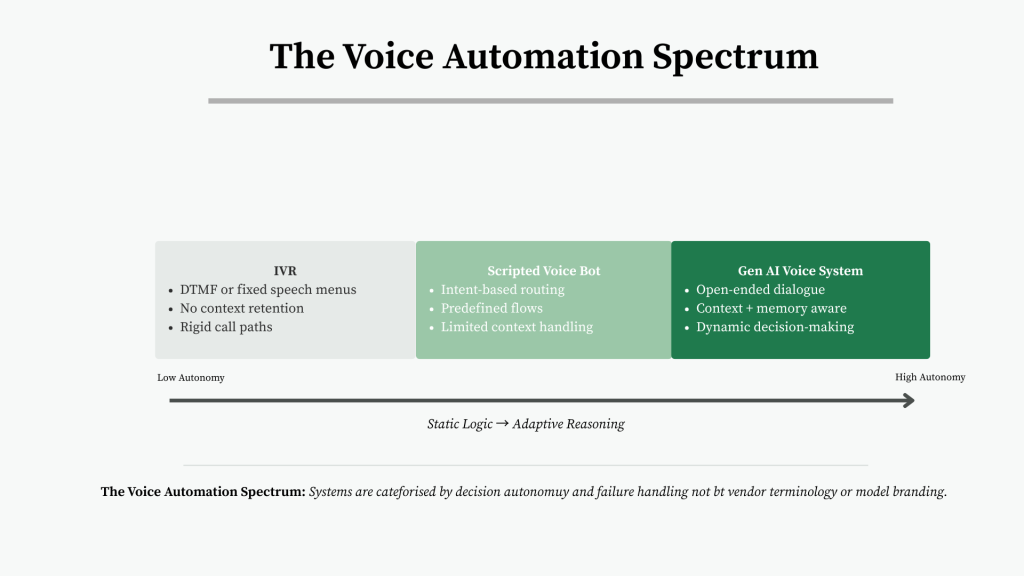
Teams frequently label any LLM-powered assistant as a “Gen AI chatbot,” but in live deployments this distinction matters. Systems that lack clear autonomy boundaries or failure recovery logic behave more like copilots or scripted bots, even if a large language model is involved. The difference shows up only under real conversational pressure—escalations, ambiguity, and user deviation.
Simplified Explanation of How Gen AI Chatbot Works
Understanding how a Gen AI powered chatbot helps buyers assess whether a solution is designed for real customer interactions or only for demonstrations.
A typical conversation flow looks like this:
- User input – A customer asks a question in natural language.
- Intent interpretation – The system interprets what the user is trying to accomplish, even if the phrasing is ambiguous.
- Knowledge retrieval and grounding – Relevant information is retrieved from approved sources such as FAQs, policy documents, or internal databases.
- Response generation – The generative model constructs a response using both retrieved information and conversational context.
- Confidence checks and escalation logic – The system decides whether to answer, ask for clarification, or hand off to a human agent.
Enterprise-grade systems typically include guardrails that limit what the model can say, as well as human-in-the-loop logic that allows escalation when confidence is low.
Understanding this flow helps buyers identify tools that rely too heavily on raw generation without sufficient grounding or control.
Gen AI Chatbot vs Agentic AI vs Copilots
One reason the category feels confusing is that vendors often collapse multiple systems into a single label.
- A Gen AI chatbot is designed for direct interaction with customers or employees, within defined conversational boundaries.
- An AI copilot assists humans rather than replacing them. It surfaces suggestions, summaries, or recommendations, but does not independently handle interactions.
- Agentic AI systems operate with higher autonomy. They can execute tasks, make decisions, and interact with other systems with minimal human involvement.
These are not interchangeable choices. Each comes with different cost, control, and risk profiles. Many enterprises begin with Gen AI chatbots because they offer measurable value while retaining human oversight—but extending beyond that requires deliberate architectural decisions.
Buyer Checklist on How to Evaluate a Gen AI Chatbot Solution
Most vendor content lists features, but evaluation requires different questions. This becomes especially important at scale, where maintaining brand tone across thousands of conversations is harder than it appears.
Key criteria to examine these platforms should include:
- Knowledge grounding: Can responses be restricted to approved sources, and can those sources be updated easily?
- Fallback behavior: How does the system respond when it is unsure?
- Consistency across channels: Does the chatbot behave the same way on web, messaging, and contact center platforms?
- Auditability: Can teams trace responses back to their sources after the fact?
- Security and compliance: Who controls prompts, rules, and updates?
- Workflow integration: Does the chatbot fit into existing support and escalation processes?
If a vendor cannot clearly explain these areas, the operational risk shifts from the technology to your teams.
How To Use Gen AI Chatbot in Real-life?
In enterprise environments, Gen AI chatbots are most effective when used within clear boundaries. Common, reliable use cases include:
- Customer support triage and routing
- Lead qualification and initial engagement
- Internal knowledge access for agents or employees
In these scenarios, the chatbot’s role is to reduce friction—not to resolve every interaction autonomously. Well-designed systems treat human handoffs as part of the experience, not as failure. In smarter customer service environments, Gen AI chatbots are most effective when paired with clearly defined escalation paths.
Competitor content often lists dozens of industry-specific use cases. In practice, value comes from applying chatbots where conversational flexibility matters, but consequences of error are manageable.
Where Gen AI Chatbots Break (And When Not to Use Them)
Gen AI chatbots fail most often in predictable ways. Common failure modes include:
- Hallucinations: Fluent but unverifiable answers when questions are ambiguous
- Over-automation: Attempting to handle emotionally sensitive or high-risk scenarios without escalation
- Context loss: Forgetting prior conversational details or contradicting earlier responses
- Lack of accountability: Inability to explain why a response was generated
Competitor blogs often avoid these limitations. Addressing them directly builds trust—and helps buyers deploy responsibly.
What to Expect from Enterprise-grade Gen AI Chatbots?
Modern Gen AI chatbots can reliably:
- Handle open-ended questions within defined knowledge boundaries
- Reduce repetitive agent workload
- Improve access to information across channels
Teams focusing on experience quality often start with intentional personality design rather than full autonomy. They still require:
- Human oversight for complex decisions
- Explicit governance and monitoring
- Ongoing tuning as policies and data change
Enterprises that succeed treat chatbot adoption as an iterative capability, not a one-time rollout.
Final Perspective
Gen AI chatbots are neither magic nor minimal tools. Their value depends on how clearly the category is defined, how carefully boundaries are designed, and how responsibly autonomy is applied.
If you are evaluating Gen AI chatbots for enterprise use, platforms like Omind position accuracy, control, and human-in-the-loop design as first-class requirements—rather than afterthoughts.
That distinction often matters more than the model itself.
See How a Gen AI Chatbot Performs in Real Conversations
If you’re evaluating Gen AI chatbots for production use, Omind can help you. See how the system handles ambiguity, escalation, and failure recovery in real scenarios.
About the Author
Robin Kundra, Head of Customer Success & Implementation at Omind, has led several AI voicebot implementations across banking, healthcare, and retail. With expertise in Voice AI solutions and a track record of enterprise CX transformations, Robin’s recommendations are anchored in deep insight and proven results.