
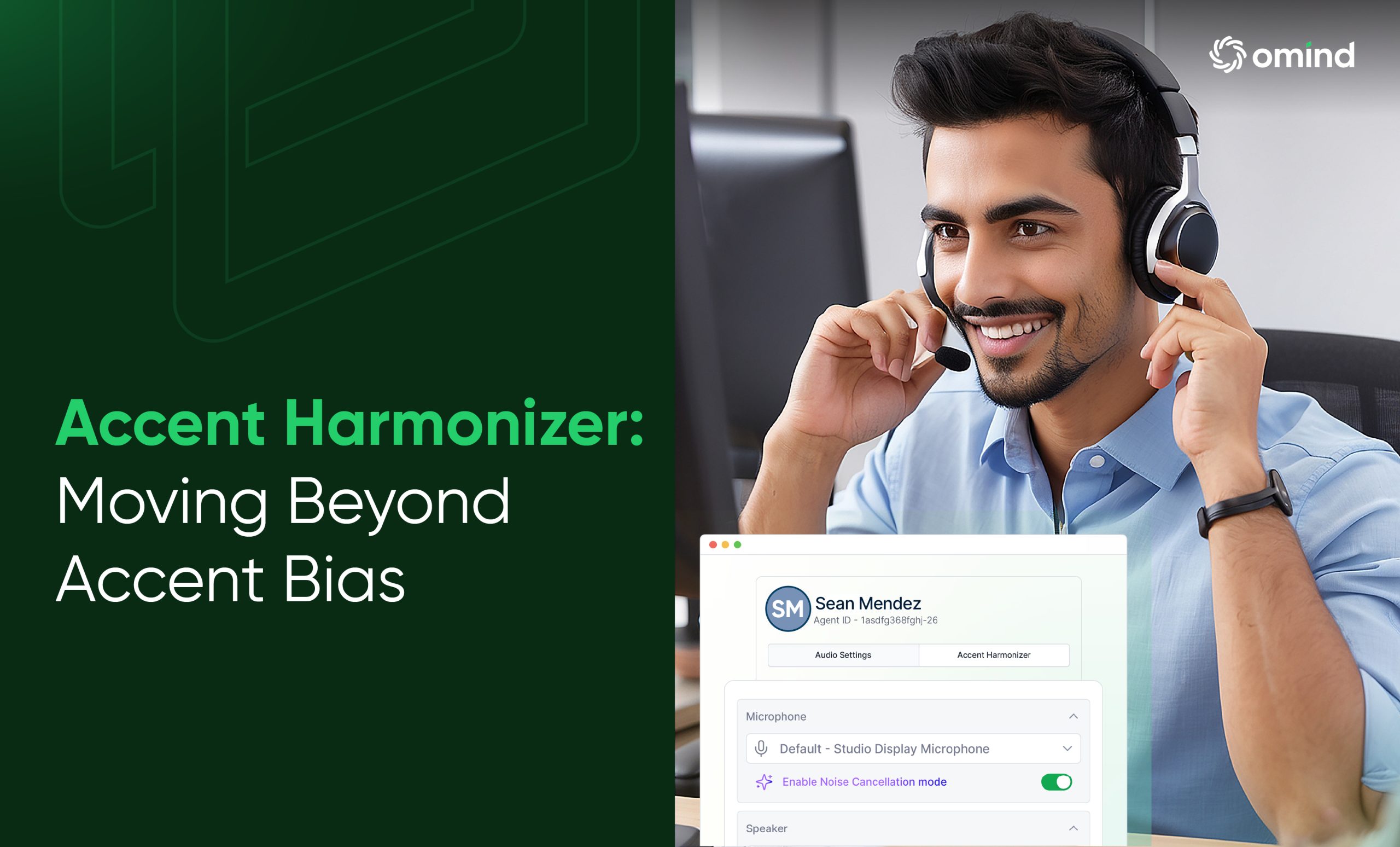

Accent bias presents a significant and persistent comprehension challenge in global conversations. The friction affects both customer experience (CX) and operational efficiency, leading to higher average handle times (AHT) and lower customer satisfaction (CSAT).
This blog explores how AI-powered accent bias removal through communication fairness. Technology supports comprehension rather than altering agent identity. It can effectively reduce misunderstanding without erasing linguistic diversity.
Accent harmonizer AI offers clearer and equitable interactions in multilingual environments. It strategically addresses common obstacles and ensures agent performance reflects skill, not clarity challenges.
Key Takeaways
- • Accent bias creates objective comprehension friction—not cultural judgment—driving higher AHT and lower CSAT.
- • AI accent harmonization adjusts only problematic phonemes in real-time while fully preserving the agent’s natural voice and identity.
- • Delivers 12–25% AHT reduction (up to 59 seconds/call) by eliminating repetition loops.
- • Boosts CSAT up to 20–26%, FCR 12–15%, and agent confidence 27%—cuts turnover up to 50%.
- • Levels the performance field: agents are evaluated on skill and empathy, not accent familiarity.
- • Drives ROI: fair, ethical clarity tool—reduces bias friction without cultural assimilation.
How Accent Bias Manifests in Contact Centers?
Accent bias functions primarily as comprehension friction, the objective difficulty listeners experience when processing varying pronunciation patterns, rhythm shifts, and unfamiliar intonation.
In realistic call scenarios, this friction leads to:
- Customer Frustration: Repeated requests for clarification and slower call flow.
- Agent Anxiety: Stress about being misunderstood, which impacts confidence and performance delivery.
- Uneven Operational Metrics: Inconsistent customer experience and skewed performance data (e.g., higher AHT for agents who struggle with clarity, regardless of their expertise).
AI-based speech clarity improvement recognizes miscommunication challenges. Agents with strong accents may possess exceptional product knowledge and empathy yet still encounter evaluation penalties tied purely to clarity—a problem technology is now solving.
AI as a Clarification Tool, Not an Assimilation Mechanism
The critical ethical line that defines truly fair AI speech processing is distinguishing what technology can and cannot do:
AI models process phonetic patterns to identify elements (strong vowel shifts, consonant compression, rapid rhythm) that obscure meaning. They then subtly adjust those elements while preserving the speaker’s core voice characteristics. This distinction is crucial: it positions technology as a communication support tool, strictly functional for mutual understanding, not a cultural assimilation mechanism.
How Accent Harmonizer AI Works With Agents?
Accent harmonizer by Omind subtly smooth the difficult-to-understand edges of speech. Technology aims to keep the speaker’s natural voice intact.
This approach delivers a fairer communication environment by:
- Targeting Clarity Bottlenecks: AI focuses exclusively on the acoustic features that cause processing difficulty for a broad spectrum of listeners.
- Maintaining Identity: It ensures the agent’s unique voice, inflection, and identity remain recognizable.
- Delivering Real-Time Improvement: The harmonization happens in milliseconds, ensuring the flow of conversation is natural and uninterrupted.
Verifiable Metrics and Industry Case Studies with Fair AI Speech Processing
For contact center leaders, the decision to invest in speech clarity tools rests on tangible, measurable results. Accent harmonization is not merely an ethical choice; it is an operational mandate for efficiency.
Industry-wide deployments of fair AI speech processing can push gains across core CX metrics. The friction caused by miscommunication has a quantifiable cost, and its removal delivers a clear return on investment.
Quantifiable Performance Improvements
According to real-world deployments and BPO case studies across the industry:
By eliminating communication friction, accent harmonization technology directly translates to operational savings and a more level performance playing field, where agent skill notes the key evaluation metric.
Building Consistent Communication Environments
AI supports clearer and more equitable communication, though it cannot eliminate human social bias itself. Integrating accent harmonizer tools into the modern CX technology stack—alongside quality monitoring and sentiment analysis—is essential for any enterprise serving diverse markets.
These systems help contact center leaders build more consistent, fair communication environments where comprehension quality does not depend on accent familiarity. The resulting level playing field ensures superior service quality and optimal agent performance.
How to Achieve AHT Reduction with AI Clarity?
With Accent Harmonizer by Omind (powered by Sanas), your team can achieve substantial efficiency gains. Let’s schedule a demo for a personalized consultation for your specific operational needs and guaranteed ROI analysis.
About the Author
Robin Kundra, Head of Customer Success & Implementation at Omind, has led several AI voicebot implementations across banking, healthcare, and retail. With expertise in Voice AI solutions and a track record of enterprise CX transformations, Robin’s recommendations are anchored in deep insight and proven results.