

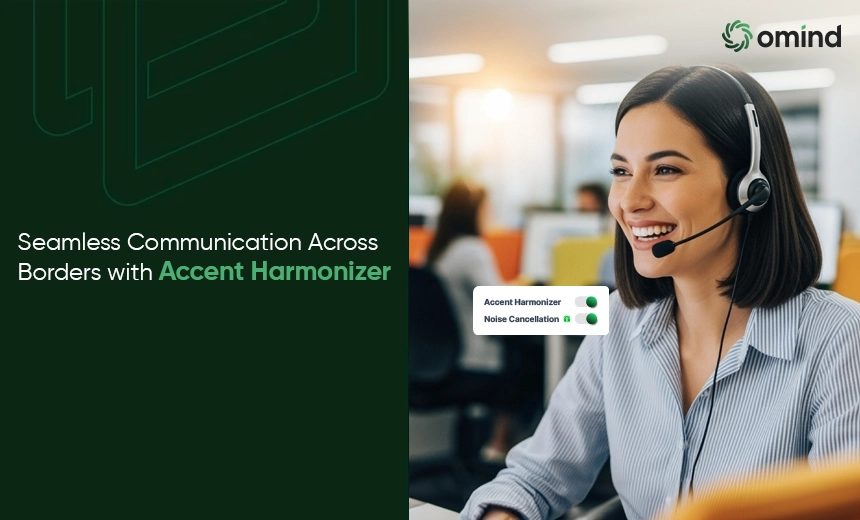

Global contact centers power customer experiences across time zones, cultures, and languages. As operations scale internationally, accent harmonization for contact centers is becoming essential. Theses platforms do not change how agents sound, but to ensure conversations remain clear, natural, and easy to follow.
Agents repeat themselves. Customers ask for clarification. Call durations stretch slightly longer than expected. None of these points to poor service or lack of skill. Instead, it reflects a growing clarity gap that appears when conversations cross borders at scale.
This is where accent harmonization for contact centers is gaining relevance—not as a corrective measure, but to support clearer, more natural global conversations.
Key Takeaways
- • Accent friction—not accents themselves—creates comprehension gaps in global contact centers.
- • Real-time harmonization smooths pronunciation patterns without altering natural voice or identity.
- • Reduces repetition, interruptions, and cognitive load for both agents and customers.
- • Enables consistent clarity across regions without restrictive hiring or accent-based routing.
- • Supports inclusive global teams while improving AHT, FCR, and overall CX quality.
- • Drives ROI: scalable clarity foundation—turns diverse voices into seamless conversations.
Real Challenge Isn’t Accents — It’s Conversational Clarity at Scale
Accents are a natural part of human communication. In global contact centers, they are unavoidable and, in many cases, a sign of a diverse and distributed workforce. The issue most operating teams face isn’t accents themselves, it’s the effort required to process them over thousands of daily interactions.
Research shows non-native accented speech can pose challenges for speech-processing systems and intelligibility when not accounted for in models trained on native speech data. When customers need to concentrate harder to follow a conversation, small frictions add up:
- Slight delays as sentences are repeated
- More interruptions to confirm understanding
- Increased cognitive load during already complex service interactions
Over time, these micro-frictions can influence average handle time, first-call resolution, and customer satisfaction—often without being clearly visible in traditional QA scorecards. Improving AI voice clarity for contact centers starts by addressing these invisible moments, not by eliminating individuality from speech.
Most global CX friction is caused by how easily customers can process conversations.
Why Traditional Approaches Don’t Scale in Global Contact Centers?
Historically, contact centers have relied on a mix of training, coaching, and manual quality assurance to address communication challenges. While valuable, these approaches face limitations as operations scale globally.
Historically, contact centers have relied on training, coaching, and quality monitoring to manage communication challenges. While each plays an important role, they address clarity issues only partially—and often after customers have already experienced friction. The differences become clearer when these approaches are viewed side by side.
As contact centers expand globally, the challenge is more on supporting every conversation as it happens. This is where accent harmonization for contact centers introduces a fundamentally different approach.
What Is Accent Harmonization in Contact Center Environments?
Accent harmonization is often misunderstood. It does not aim to neutralize accents or change how agents sound. Instead, accent harmonization for contact centers focuses on improving intelligibility while preserving the agent’s natural voice.
Rather than altering identity, harmonization works at a phonetic level, subtly smoothing pronunciation patterns that commonly cause misunderstanding. The goal is not to make everyone sound the same, but to make conversations easier to follow.
In practice, this means:
- The agent speaks naturally, without conscious adjustment
- The customer hears clearer, more consistent speech
- The interaction remains human, fluid, and uninterrupted
This distinction matters, especially for global enterprises prioritizing inclusion and authentic communication.
How Real-time Accent Harmonization Works During Live Calls?
Unlike offline processing or post-call analysis, real-time accent harmonization operates continuously during live conversations. It functions as a background layer of intelligence rather than a visible intervention.
- Real-time Phonetic Analysis: The system listens to speech patterns as the conversation unfolds, identifying phonetic elements that may affect clarity. This happens without introducing noticeable latency or disrupting call flow.
- Context-aware Adjustments: Instead of applying rigid transformations, harmonization adapts to conversational context. Adjustments are subtle, avoiding robotic tones or synthetic artifacts. The agent’s voice remains recognizable and natural.
- Seamless Integration: Accent harmonization works alongside existing technologies such as noise cancellation, routing, and monitoring tools. For agents and customers, there is nothing new to learn or manage—the improvement is experienced, not configured.
“The best voice AI doesn’t interrupt conversations—it quietly improves them.”
Why Enterprise Contact Centers Are Adopting Voice AI for Clarity
As organizations scale across regions, consistency becomes harder to maintain. Enterprise contact centers manage thousands of agents across multiple accents, languages, and cultural nuances. Relying solely on hiring criteria or routing logic to manage clarity introduces operational complexity.
Enterprise-grade voice AI solutions focuses on clarity are gaining traction. They offer:
- More uniform customer experiences across regions
- Faster onboarding for agents serving international customers
- Reduced dependence on accent-based routing or selective staffing
- Support for inclusive hiring without compromising conversation quality
Rather than forcing operational trade-offs, voice AI enables enterprises to scale globally while maintaining conversational consistency.
Business Impact of AI Voice Clarity in Contact Centers
Improved clarity influences contact center performance in ways that are often indirect but meaningful. When customers understand agents more easily, conversations tend to progress with less friction.
Potential outcomes include:
- Fewer repeated explanations during calls
- Smoother conversational pacing
- Reduced customer effort during problem resolution
- Greater agent confidence in cross-border interactions
These improvements do not stem from changing what agents say, but from ensuring what they say is easier to understand. Over time, AI voice clarity for contact centers supports both experience quality and operational efficiency.
Accent Harmonization as a Foundation for Global CX
As customer expectations rise, global CX strategies are moving beyond language translation alone. Clear communication requires attention to how speech is perceived, not just what is spoken.
Accent harmonization plays a foundational role in this shift. By addressing clarity at the voice level, enterprises create space for more advanced voice AI applications—without first solving basic intelligibility challenges.
In this context, harmonization is not a feature layered on top of CX—it becomes part of the infrastructure that enables scalable, human-centric global conversations.
Clear Conversations Power Global Contact Centers
Global contact centers thrive on connections. When conversations flow naturally, customers feel understood and agents feel empowered. Accent harmonization for contact centers supports this outcome by improving clarity without erasing individuality.
Through real-time accent harmonization, enterprises can reduce conversational friction while respecting the diversity of global teams. Combined with modern enterprise voice AI solutions, this approach helps contact centers deliver consistent, high-quality experiences across borders.
As contact centers continue to expand globally, clarity will remain a defining factor of customer trust. Accent harmonization ensures that trust is built conversation by conversation—quietly, naturally, and at scale.
Accent Harmonization Improves Global Call Clarity
See how real-time accent harmonization supports clearer conversations.
Let’s schedule a walkthrough to know more.
About the Author
Robin Kundra, Head of Customer Success & Implementation at Omind, has led several AI voicebot implementations across banking, healthcare, and retail. With expertise in Voice AI solutions and a track record of enterprise CX transformations, Robin’s recommendations are anchored in deep insight and proven results