
How to Evaluate an AI Voicebot for Customer Support Before Deployment?
Enterprise contact centers are increasingly turning into an AI voicebot for customer support to reduce costs without eroding customer experience. Gartner predicts that AI deployments will slash agent labor costs by $80 billion by 2026. However, in practice, many enterprise deployments stall at the pilot stage. Many organizations are realizing that modern contact centers use ai voice bots to transform customer support as a primary driver of efficiency. AI voicebots are often positioned as the answer: handle high volumes, deflect routine calls, and free human agents for complex issues. In theory, this makes sense. In practice, many enterprise deployments stall at […]
Where Gen AI Chatbots Break Down in Enterprise Use Cases?
From hallucinations to handoff breakdowns, Gen AI chatbots often struggle once they move beyond pilots. This article examines where those failures occur in real enterprise environments—and what separates early success from systems that scale. Key Takeaways • Demos impress but hide production realities—hallucinations, latency, and cost spikes emerge only at scale. • Hallucinations in business-critical flows erode trust—confident but wrong answers are worse than silence. • Latency and token costs compound rapidly in high-volume environments—early pilots mask this reality. • Poor handoff design loses context—customers repeat themselves, agents lose time, satisfaction drops. • Monitoring gaps make quality drift invisible—non-deterministic outputs demand […]
Why Most AI Voicebots Fail Months After Deployment in Customer Support
Most AI voicebots don’t fail at launch. They pass pilots and meet early containment targets. The dashboards show improvement, ensuring leadership moves on and look other way just as the customer experience slip. Then, a few months later, something shifts. Customers start repeating themselves. Agents quietly reroute calls. Escalations increase, but not in a way that triggers alarms. The voicebot is still “live,” but trust in it is fading. This is the most common failure pattern in AI voicebots for customer support today—and it has very little to do with whether the bot uses generative AI or how impressive the demo […]
How AI Powered Voice Assistants Transform Customer Conversations?
For years, “voice assistant” meant one thing: an IVR that forced customers to listen carefully, press the right number, and hope the system didn’t misunderstand them. Most people didn’t call these systems helpful. They called them obstacles. That’s changing—but not for the reasons most vendor blogs claim. AI powered voice assistants are not transforming customer conversations because they sound more human or because they use buzzwords like “context” and “emotion.” They’re changing things because they finally stop forcing customers to adapt to machines. The real shift is structural, not cosmetic. Key Takeaways • Legacy IVR forces customers into rigid menus and […]
How Voicebot for Call Center Boosts Sales & Customer Satisfaction in Retail?

Retail call centers operate under constant pressure. Flash sales, festive seasons, delivery delays, and return requests can push call volumes far beyond what human agents alone can manage. When customers wait too long for simple answers, the result is predictable: abandoned calls, missing sales opportunities, and declining satisfaction. Retail brands are exploring voicebot for call center operations to handle volume, speed up responses, and protect both revenue and customer experience. This article breaks down how voicebots function in retail environments, where they add the most value, and why they are becoming relevant for modern retail call centers. Key Takeaways • Retail […]
Can AI-driven Accent Harmonization Help Support Teams Work Smarter?
Global call centers increasingly rely on diverse, multilingual agent teams to scale operations across regions and time zones. While this model expands talent access, it also introduces a persistent challenge in voice-based support: accent-related communication friction. Even when agents are fluent and well-trained, customers may struggle to follow conversations smoothly. This friction is not an indicator of agent capability or effort. It is a communication problem inherent to voice interactions, where comprehension speed directly influences call flow. As contact centers face rising pressure to improve efficiency within existing operating constraints, AI accent neutralization for call centers reduces friction and supports better […]
Accent Clarity and Decision Friction in Contact Center Conversations

In contact centers, customer decisions rarely stall because of a single major failure. More often, they slow down due to small moments of hesitation—requests for repetition, pauses before confirmation, or uncertainty about next steps. These moments are easy to dismiss as routine conversational noise. However, over the course of an interaction, they can accumulate into what many CX leaders describe as decision friction. Accent clarity in customer conversations play a critical role in how easily customers process information and make decisions during live interactions. Not accents themselves, but how easily can customers process and understand spoken information in real time. Key […]
How AI Voice Engagement Improves Customer Satisfaction and Loyalty?

Customer satisfaction and loyalty increasingly depend on how easy, natural, and responsive a brand’s support experience feels. Whether a customer is asking a question, booking a service, or seeking help after hours, they expect the process to be fast and intuitive. Traditional IVR systems rarely provide that ease. They rely on rigid menu structures, offer little personalization, and often extend resolution times. AI voice engagement—powered by conversational AI capable of understanding natural speech—has emerged as a more intuitive alternative. It helps brands deliver human-like interactions, faster resolutions, and round-the-clock responsiveness. These are essential ingredients for customer satisfaction with AI and long-term […]
How Automation Becomes the Backbone of Modern Quality Management Systems?
As enterprises scale operations across teams, channels, and geographies, quality management systems (QMS) are under increasing pressure. What once relied on periodic audits and manual reviews is now expected to support continuous oversight, faster decision-making, and consistent standards at scale. In this context, automation in quality management systems is no longer an enhancement—it has become structural. Rather than replacing human judgment, automation increasingly serves as the backbone that supports modern quality operations, helping organizations manage complexity while maintaining control. Key Takeaways • Traditional QA relies on manual sampling (1–3% coverage), creating blind spots, subjectivity, and delayed feedback. • Automation in QMS […]
Designing Voice AI for High-stakes Industries: Banking, Healthcare, and Insurance
High-stakes industries such as banking, healthcare, and insurance operate under constant pressure to deliver fast, accurate, and compliant customer interactions. These environments handle sensitive data, complex workflows, and time-critical decisions—where errors carry financial, legal, and human consequences. Voice AI for industries is increasingly becoming the operational layer that helps these organizations scale voice interactions without compromising control. Using natural language processing (NLP), automatic speech recognition (ASR), and text-to-speech (TTS), enterprise Voice AI solutions automate repetitive conversations while maintaining consistency, availability, and governance. This blog explores how Voice AI is applied across BFSI, healthcare, and insurance—and what it takes to deploy it […]
Accent Harmonizer Software for Contact Center Balances Natural Speech
Speech is more than just sound. Every conversation carries meaning through accent, tone, rhythm, and emotion. These features reflect our culture, identity, and background. Accent harmonizer software helps make speech clearer while finding the right balance between clarity and trust. This blog explains how real-time accent correction tool help global agents to communicate clearly and confidently with customers. Key Takeaways • Accent friction adds 15–20% to AHT; harmonizer software bridges clarity gaps in global calls. • Traditional noise tools fix environment; AI harmonizers adjust vowels, consonants, and prosody for phonetic clarity. • Real-time workflow: capture speech, detect friction, reconstruct clarity—preserves tone […]
How to Build Voicebots That Know When to Escalate to Agents (And Save Your CX)
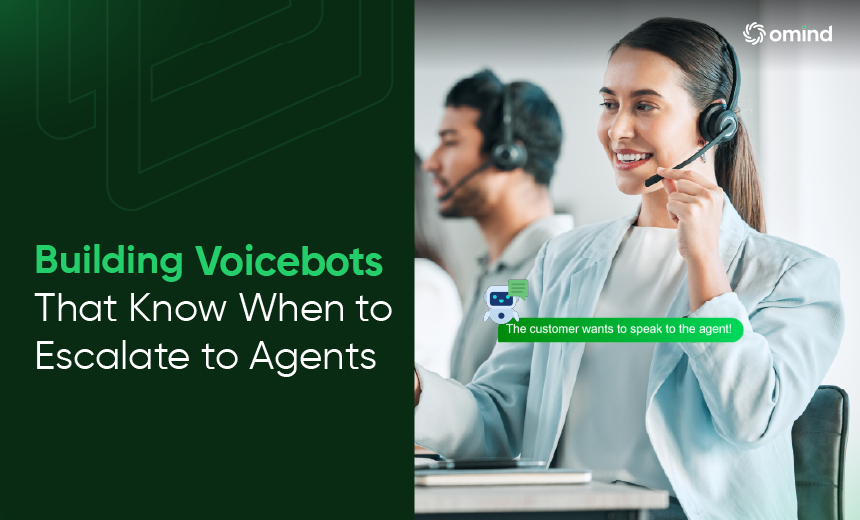
Contact centers have spent years trying to automate the front line. Yet the biggest frustration customers still face isn’t just that a Gen AI voicebot for customer service can’t answer everything — it’s that these tools often don’t know when to stop talking. They repeat the same lines, provide irrelevant answers, and cling to the conversation even when the customer clearly needs a human. Gartner reports that only 14% of customer service issues are fully resolved through self-service channels like voicebots, implying an 86% failure rate for bot-led resolutions. As practitioners who have built and optimized thousands of contact center conversations, […]