
AI Accent Harmonizer Modulation Upgrades Voice Clarity in Global Conversations

In global contact centers, a single misunderstood word can extend a call, frustrate a customer, or derail a deal. AI accent harmonizer modulation introduces a new clarity layer — enhancing speech intelligibility in real time, without changing who an agent sounds like. Key Takeaways • Accent friction in global calls causes repetition, longer AHT, lower FCR, and eroded trust—even when agents are fluent. • Real-time AI accent harmonizer selectively adjusts phonemes, stress, and rhythm to boost listener intelligibility. • Preserves natural voice identity, tone, emotion, and intent—avoids synthetic or robotic output. • Reduces clarification loops and cognitive load—calls flow faster with […]
How Do Enterprises Automate Customer Conversations With AI-enabled Voicebots?

Most writing about AI voicebots focuses on automation rates and deployment speed. That framing misses the real reason most implementations underperform: customers don’t understand what they hear, and the bot doesn’t understand what they say. In global contact centers, clarity is the difference between a resolved call and a dropped one. Here’s what enterprises need to get right. Key Takeaways • Enterprises adopt AI voicebots to handle surging call volumes, reduce abandonment, and scale support without proportional headcount growth. • Gen AI voicebots understand natural speech, retain multi-turn context, and complete tasks end-to-end — far beyond rigid IVR menus. • Pipeline: […]
Voice AI for Customer Service Supporting Contact Center Automation

From real-time pipelines and multilingual voicebots to vendor evaluation frameworks — everything enterprise CX leaders need to know. Most voicebots fail for one simple reason: they cannot understand customers in real time. Long pauses, incorrect responses, and rigid scripts turn automation into frustration. Modern Gen voice AI for customer service solves this by enabling natural conversations, real-time responses, and intelligent collaboration between AI systems and human agents. The provided content offers a comprehensive overview of **Voice AI for customer service**, highlighting its evolution from legacy IVR to generative AI-powered voicebots, key enterprise use cases, multilingual capabilities, platform requirements, vendor evaluation criteria, and future […]
How Real-time Accent Harmonizer Works in Live Customer Conversations?

Most pages about real-time accent harmonizers tell you why clarity matters. Almost none explain what is being changed in a live audio streamor how to evaluate whether it’s helping or hurting trust. This guide closes that gap, breaking down how accent harmonization works in real time, where it delivers measurable value, and where it should not be used. Key Takeaways • Real-time accent harmonization selectively adjusts phonemes, stress, and rhythm to boost intelligibility—without erasing voice identity or emotional tone. • Unlike training (slow, variable) or neutralization (synthetic, identity-eroding), harmonization is live, targeted, and preserves authenticity. • Reduces repetition loops, clarification delays, and cognitive load—calls […]
What Drives Gen AI Chatbot Solutions in Call Centers and Shapes Performance?

Gen-AI chatbots deployed in contact centers often behave inconsistently—even when they appear to use the same underlying model. One handles ambiguity calmly. Another escalates prematurely. A third collapses under edge cases. These differences are frequently attributed to “model quality,” but that explanation is incomplete and often misleading. In production environments, chatbot behavior is not determined by the model alone. It emerges from system design choices: how models are constrained, how context is supplied, how memory is handled, and how failures are bounded. Two chatbots can share a model and still behave in fundamentally different ways because they are embedded in different […]
Why Are Contact Centers Adopting AI Voice Harmonization for Measurable Performance Gains?

AI voice harmonization is increasingly being evaluated by contact center leaders to improve call performance metrics such as Average Handle Time (AHT), First Call Resolution (FCR), and Customer Satisfaction (CSAT). The interest is not driven by novelty, but by a persistent operational problem: customers and agents losing time inside conversations due to mishearing, repetition, and clarification loops. In high-volume contact centers, these breakdowns are measurable. They lengthen calls, increase callbacks, and create inconsistent customer experiences across teams. This is particularly critical when implementing AI voice harmonization for banking financial companies, where a single misheard digit or a misunderstood policy detail can […]
Why Accent Translation Tool Is Becoming Critical for Contact Centers?

If the issue was truly resolved, customers wouldn’t call back. Yet repeat calls remain a persistent problem across contact centers even when agents follow scripts, systems work as intended, and issues are technically addressed. The breakdown isn’t effort or intent. It’s understanding. One of the most under-recognized causes is accent friction. Even in English-speaking interactions, differences in pronunciation, rhythm, and phonetics can quietly disrupt comprehension. The issue isn’t language fluency—it’s clarity under pressure. When customers don’t fully absorb information the first time, they often call again to reconfirm, clarify, or correct what was misunderstood. That’s why many contact centers are now […]
Telecom Teams Use Gen AI Voicebots to Manage High-Volume Support Calls

Telecom support teams operate under conditions most customer service environments never face. Inbound volumes surge around billing runs, prepaid recharges, plan migrations, and SIM activations. Additionally, it is often within narrow windows where even minor issues trigger repeat calls. Add an unplanned network disruption or service degradation, and queues can grow faster than teams can respond. Over time, these patterns expose a structural mismatch. Headcount scales slowly, training lags new offerings, and customers often enter support already frustrated by delays or prior failed attempts. Traditional fixes—adding agents or extending IVR menus—tend to absorb cost without stabilizing demand. This is why many […]
Gen AI Transforms Voicebots from Scripts to Context-Aware Conversations
Generative AI voicebots are redefining how enterprises approach voice automation. Voicebots have been part of enterprise automation for years. Most early deployments followed a predictable pattern: define intents, design scripts, and guide callers through structured paths. These systems delivered value by reducing call volumes and handling routine queries, but they also exposed a hard ceiling. Once a conversation deviated from the script, the experience broke down. Generative AI has shifted that ceiling. Instead of forcing human conversations into rigid flows, modern voicebots can now interpret context, adapt mid-call, and respond more flexibly. This shift is not about replacing humans or achieving […]
Accent Harmonization Improves Contact Center Conversations Across Borders
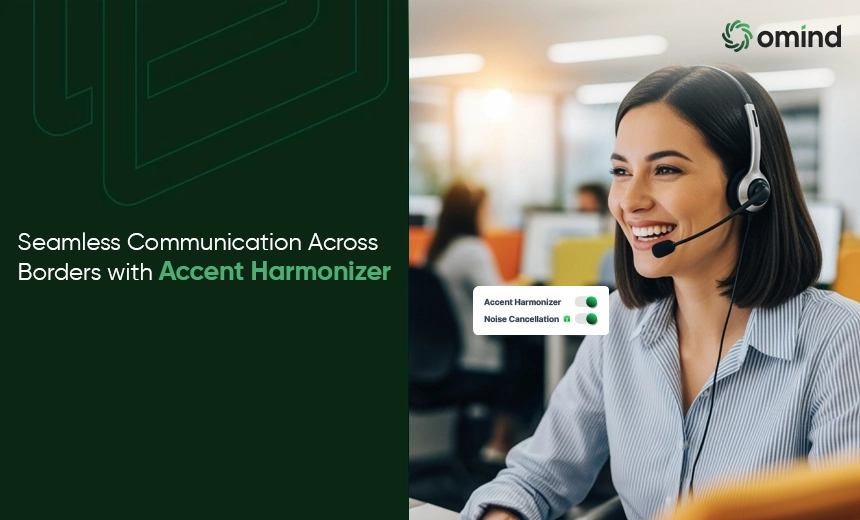
Global contact centers power customer experiences across time zones, cultures, and languages. As operations scale internationally, accent harmonization for contact centers is becoming essential. Theses platforms do not change how agents sound, but to ensure conversations remain clear, natural, and easy to follow. Agents repeat themselves. Customers ask for clarification. Call durations stretch slightly longer than expected. None of these points to poor service or lack of skill. Instead, it reflects a growing clarity gap that appears when conversations cross borders at scale. This is where accent harmonization for contact centers is gaining relevance—not as a corrective measure, but to support […]
Standardizing on Accent Harmonization for Frictionless Contact Center Workforce
Workers spend 3.2 hours per week trying to understand or gain clarity from someone’s poor communication. That’s 166 hours a year per employee just decoding unclear messages. The communication challenges like unclear speech, misinterpretations, and similar issues quietly drain $10,689 per employee annually in lost productivity. Moreover, these challenges slow down workflows and introduce friction into customer interactions for both speakers and listeners. Legacy approaches such as accent training, voice modulation, or full voice conversion were designed for limited contexts. They do not align with the speed, scale, or diversity of modern teams. Accent harmonization with AI integration changes the model. […]
Understanding Voice AI ROI for Modern Contact Centers

Voice AI has become a financial decision as much as a technical one. With rising call volumes and constant pressure to deliver consistent, always-on service, the real question is no longer whether automation works—it’s how much economic value it creates at scale. Evaluating Voice AI ROI goes far beyond cost-per-call reductions. Leaders now look at how how it may influence operational resilience, service continuity during peak periods, and capacity planning without assuming proportional headcount growth. These factors—scalability, continuity, and experience consistency—form the core of Voice AI’s economic impact. To assess ROI effectively, organizations need a structured method: defining strategic goals, understanding […]